AASHTO Green Book Design Vehicles: Sources, Access and Free Alternatives (USA)

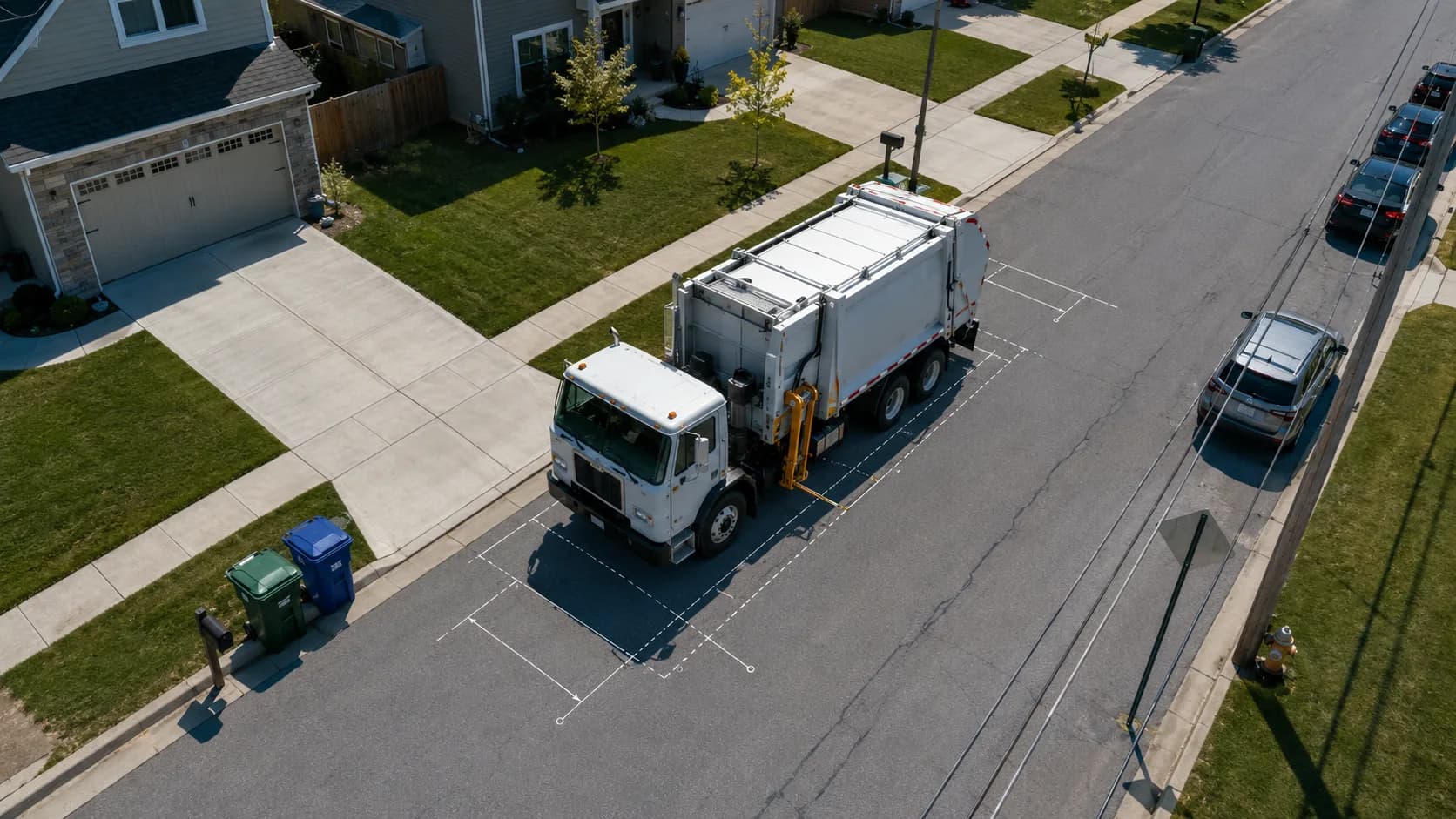
The AASHTO Green Book, formally A Policy on Geometric Design of Highways and Streets, defines the standardised "design vehicles" (P, SU-30, BUS-40, WB-62, WB-67 and more) used across US transportation engineering.
Short answer. No, you cannot legally download the official AASHTO Green Book vehicle dimensions for free. The Green Book (7th Edition, 2018, item GDHS-7) is copyrighted by AASHTO, a private 501(c)(3), so federal incorporation by reference (23 CFR 625.4) does not place it in the public domain. For a federal-aid or state DOT submission you need the official Green Book, or CAD software that ships AASHTO-derived vehicles. For private pre-design and feasibility, free public sources (23 CFR Part 658 truck limits, the MUTCD and state DOT manuals that reproduce the AASHTO classes) are usually enough.
This guide explains what the AASHTO design vehicles are, what their codes actually mean (the most common misreading is fixed below), why you cannot simply download the dimensions, how to obtain them legally, and which free public US sources are enough for pre-design swept-path work.
Quick reference
| What you need | Free? | Where to get it |
|---|---|---|
| Official AASHTO design-vehicle dimensions | No | AASHTO Green Book, or a CAD package that ships AASHTO-derived vehicles |
| Federal truck size and weight limits | Yes | 23 CFR Part 658 (govinfo.gov) |
| Design-vehicle classes and turning templates | Yes | State DOT manuals (TxDOT, Indiana DOT) |
| Real chassis dimensions and turning circles | Yes | Manufacturer specification sheets |
| Swept-path simulation, standard vehicles | Free | PathSweeper |
| Swept-path simulation, AASHTO classes | Projekt Pass | PathSweeper |
What are AASHTO design vehicles?
AASHTO groups design vehicles into four classes: passenger cars, buses, trucks and recreational vehicles. Each gets a code:
- P: passenger car
- SU-30 / SU-40: single-unit (rigid) truck. The number is the overall length in feet (SU-30 = 30 ft). The metric edition named the same vehicles SU-9 / SU-12.
- BUS-40, BUS-45: intercity coaches (40 ft, 45 ft overall)
- CITY-BUS: 40 ft city transit bus; A-BUS: articulated bus; S-BUS-36 / S-BUS-40: school buses
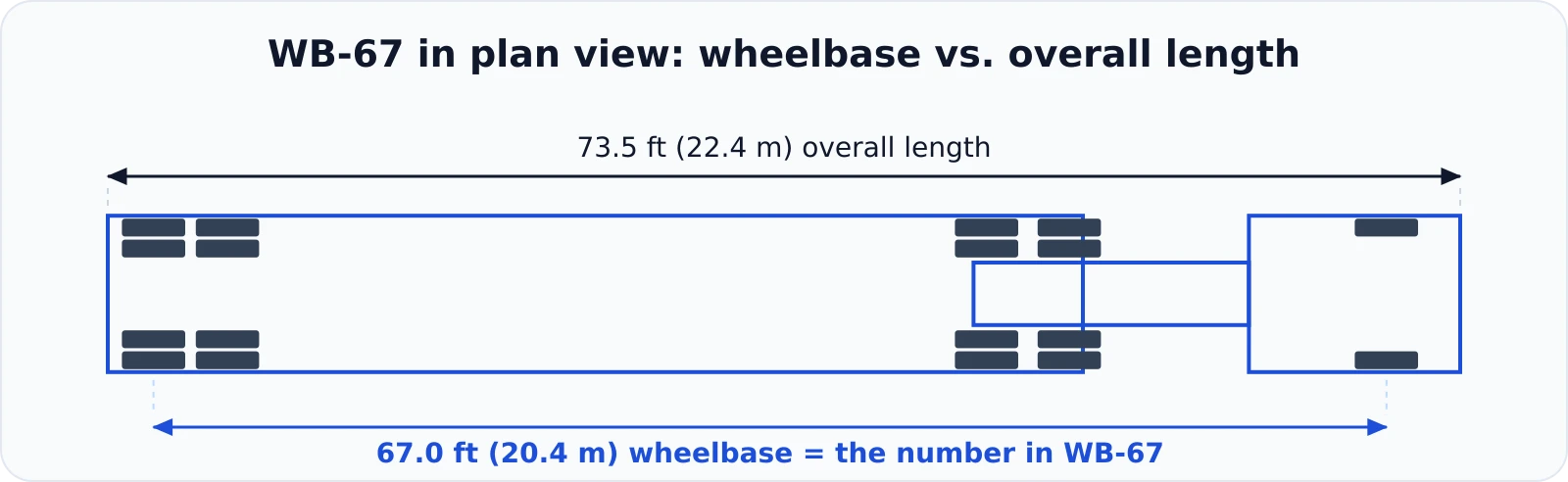
- WB-40, WB-62, WB-67: tractor-semitrailer combinations. Here WB stands for wheelbase, and the number is the wheelbase, not the overall length
- WB-100T: triple-trailer combination; WB-109D: turnpike-double combination
- MH: motor home; MH/B: motor home with boat trailer; P/T: car with camper trailer; P/B: car with boat trailer
The AASHTO definition is worth quoting, because it differs from European practice. Design vehicles are "selected vehicles, with representative weight, dimensions, and operating characteristics, used to establish highway design controls"; each "has larger physical dimensions and a larger minimum turning radius than most vehicles in its class," and the designer should "consider the largest design vehicle that is likely to use that facility with considerable frequency." Unlike the German RBSV 2020, AASHTO does not describe them as an "85th-percentile" vehicle. The idea is similar, a deliberately conservative reference, but the percentile language is European, not AASHTO.
The code detail that causes the most confusion
For single-unit trucks and buses the number is overall length: an SU-30 is 30 ft long, a BUS-40 is 40 ft long. For WB combinations the number is the wheelbase:
- WB-67 has a 67 ft wheelbase but an overall length of about 73.5 to 74 ft. It is the dominant US line-haul configuration (tractor plus a 53 ft trailer) and is often called the interstate design vehicle.
- WB-62 has a 62 ft wheelbase and a 68.5 ft overall length.
- WB-40 is 45.5 ft overall.
If you size a bay or a gate off "67 ft" thinking that is the truck length, you will be about 7 ft short. Seattle DOT states this explicitly for the WB-67, and the wheelbase-versus-length split is visible in the dimensioned figures reproduced in free state DOT manuals such as Indiana DOT's.
Typical US design-vehicle dimensions (public sources only)
The table below is not a reproduction of the official Green Book values. It is assembled from the federal STAA limits, free state DOT manuals and public manufacturer spec sheets, as typical figures for pre-design and feasibility. For a permitted federal-aid or state DOT project you will need the Green Book itself.
| Class | Overall length | Wheelbase / spacing | Turning circle |
|---|---|---|---|
| P passenger car | 4.6-5.1 m (15-17 ft) | 2.7-2.9 m | 11-12 m |
| Pickup / light truck | 5.9-6.4 m (19-21 ft) | 3.7-4.1 m | 14-15 m |
| SU-30 single-unit truck | 9.1 m (30 ft) | 6.1 m | ~ 25 m |
| SU-40 single-unit truck | 12.2 m (40 ft) | 7.6 m | ~ 30 m |
| BUS-40 intercity coach | 12.2 m (40 ft) | 7.3-7.6 m | ~ 25-27 m |
| BUS-45 intercity coach | 13.7 m (45 ft) | 8.0 m | ~ 27-29 m |
| CITY-BUS transit bus | 12.2 m (40 ft) | 7.6 m | ~ 25 m |
| A-BUS articulated bus | 18.3 m (60 ft) | 6.1 m + 6.7 m | ~ 24-26 m |
| WB-62 53 ft semi | ~ 20.9 m (68.5 ft) | 62 ft (18.9 m) | ~ 28 m |
| WB-67 interstate semi | ~ 22.4 m (73.5 ft) | 67 ft (20.4 m) | ~ 28-30 m |
| MH motor home (Class A) | 10-13.7 m (33-45 ft) | 6-8 m | ~ 22-28 m |
Widths: heavy vehicles 2.59 m (102 in), passenger car ~1.85 m, pickup ~2.03 m. Sources: federal STAA truck-size limits (23 CFR 658); free state DOT manuals (TxDOT, Indiana DOT); public manufacturer spec sheets (Volvo VNL, Freightliner Cascadia, MCI J4500, New Flyer Xcelsior). Figures are typical values for pre-design, not the official AASHTO Green Book values, and vary by manufacturer and configuration. All information without guarantee.
Why you cannot just Google the Green Book numbers
The Green Book is published by AASHTO, the American Association of State Highway and Transportation Officials, a private non-profit of the state DOTs, tax-exempt under 501(c)(3) since 1944. It is not a federal agency, and that distinction is the whole story:
- US federal works (statutes, FHWA publications, the MUTCD) are public domain under 17 U.S.C. 105.
- AASHTO publications are private copyrighted works. There is no US analogue to Germany's official-works exemption that would free them.
Federal regulation 23 CFR 625.4 incorporates AASHTO GDHS-7, 7th Edition, 2018 by reference as a design standard for the National Highway System. Incorporation by reference means the regulation legally points at the document; it does not turn AASHTO's text into a public-domain federal work, so state DOTs and consultants still buy the official Green Book to read the values.
One honest nuance, because it is often overstated online: a US appeals court held in ASTM v. Public.Resource.Org (D.C. Circuit, 2023) that non-commercial dissemination of law-incorporated standards can be fair use. That is a narrow, fact-specific defence, not a ruling that the standard is public domain. AASHTO keeps the copyright, and reproducing the full design-vehicle tables commercially is not permitted, which is why a web search returns only fragments and contradictory values.
Three legal ways to get the official values
1. Buy the Green Book from AASHTO. The current edition is the 7th Edition (2018), item code GDHS-7, ISBN 978-1-56051-676-7. Per AASHTO's own design publications catalog it is sold in three formats:
| Format | Item code | List price | Member price |
|---|---|---|---|
| Single-user PDF download | GDHS-7-UL | $342 | $253 |
| Paperback | GDHS-7 | $427 | $316 |
| Paperback + PDF combo | GDHS-7-PUL | $598 | $443 |
You can buy it on the AASHTO store. An 8th Edition is in development (NCHRP Project 07-29); as of this writing the research and draft phase completed in March 2026, but AASHTO's publication decision is still pending and no 8th Edition is for sale, so the 7th Edition remains the current standard.
2. Use CAD software that ships AASHTO-based design vehicles. Vehicle Tracking (Autodesk), Civil 3D Country Kit (US), Bentley OpenRoads Designer and AutoTURN (Transoft) are commonly reported to ship AASHTO design vehicles, but the bundled content changes between releases: verify the current AASHTO content with the vendor before relying on it for billable work.
3. Use free public sources. A surprising amount of usable design-vehicle information sits in the US public domain:
- 23 CFR Part 658 (federal STAA truck-size limits) is free at govinfo.gov and 23 CFR 625.4 (the design-standards rule) at law.cornell.edu.
- The MUTCD, 11th Edition with Revision 1 (FHWA, December 2025), is a free federal work at mutcd.fhwa.dot.gov. It governs signs, signals and markings, not vehicle dimensions, so do not cite it for turning geometry, but it is the federally mandated reference for traffic-control design.
- State DOT design manuals are widely published online for free and reproduce the AASHTO design-vehicle classes, definitions and turning templates. Two clean, deep-linkable examples: TxDOT Roadway Design Manual 4.3.2 Design Vehicles and the dimensioned turning figures in the Indiana DOT Design Manual. Caltrans, FDOT and others publish similar chapters.
- Manufacturer spec sheets (Volvo Trucks NA, Freightliner, Peterbilt, Kenworth, Mack for trucks; MCI and Prevost for motorcoaches; New Flyer for transit) publish chassis dimensions, wheelbases and turning circles publicly.
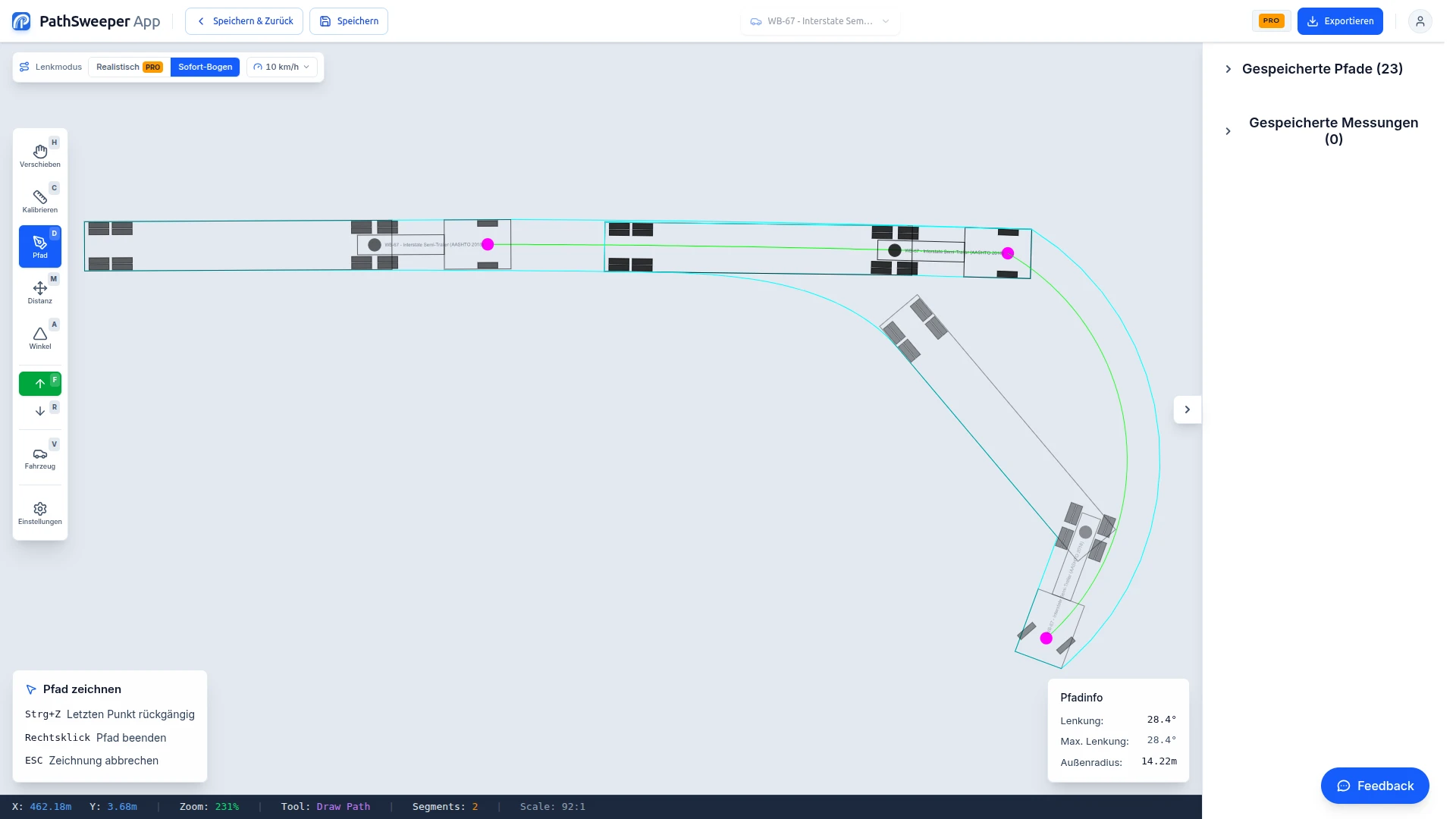
A ready-made version of that public-source route. Assembling those classes by hand from state DOT manuals and manufacturer sheets is workable but slow. PathSweeper ships a US design-vehicle library covering the common AASHTO classes (P, SU-30, BUS-40, WB-62, WB-67 and more), built from those same public sources and cross-checked against an independent swept-path engine, ready to simulate in the browser with no CAD licence and no install. The Projekt Pass is a one-time unlock per project, not a subscription, currently the cheapest one-time option we know of for US swept-path work. It is not a substitute for the official Green Book where a certified federal-aid or state DOT submission requires it (see the table below).
Federal size limits you can rely on for free
These are the federal floors and ceilings on the National Network, straight from 23 CFR Part 658 (public domain):
- Width: 102 inches (2.59 m) maximum on the National Network (Hawaii keeps a 108-inch limit). This is wider than the European 2.55 m.
- Semitrailer length: 48 ft is the federal floor states must allow. 53 ft is not a federal number: it is a state-adopted/grandfathered length, common but state-dependent, so verify per state.
- Twin trailers: 28 ft each.
- Bus: 45 ft is the minimum states must allow (states may permit longer).
- Height: no federal limit. States set it, typically 13 ft 6 in (4.11 m) to 14 ft 0 in (4.27 m). Claims that the STAA sets a federal 13 ft 6 in height standard are incorrect; Part 658 contains no height provision.
When the official Green Book is required vs. when free sources are enough
| Situation | Recommendation |
|---|---|
| Federal-aid project on the NHS / state DOT submission | Green Book required (23 CFR 625.4): buy it, or use a CAD package that ships AASHTO-based vehicles |
| Local agency project that defers to the state DOT manual | Free state DOT manual + manufacturer data is usually sufficient |
| Private developer / pre-design / feasibility | Federal STAA limits (23 CFR 658) + manufacturer spec sheets, or PathSweeper's US vehicle library |
| Site-plan review where the city explicitly cites AASHTO | Green Book, or a CAD package that ships AASHTO-based vehicles |
| Education / research / journalism | Citing individual values with attribution is generally defensible; full table reproduction is not |
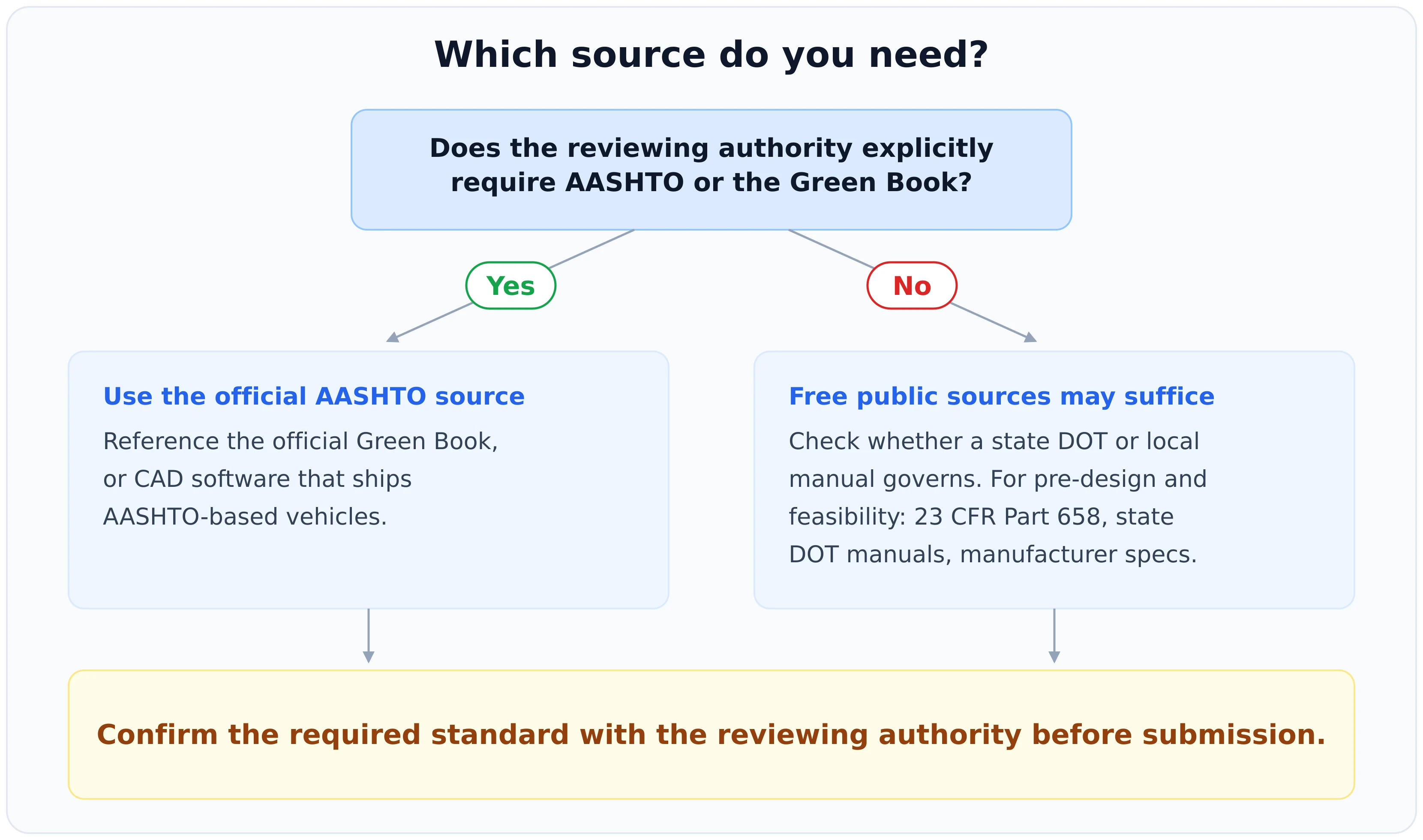
When in doubt, ask the reviewing agency in writing before starting work which standard governs. It is their citation that counts, not which source is most common.
Where AASHTO design vehicles are used in practice
- Intersection and roundabout geometry (turning-path templates)
- Highway and street cross-section design
- Truck-route and freight-corridor planning
- Bus stop, bus bay and transit-centre design
- Driveway, loading-dock and site-plan review
- Fire-department access, in conjunction with the IFC and NFPA 1, which set apparatus access geometry in the US (not AASHTO)
Which US design vehicles does PathSweeper offer?
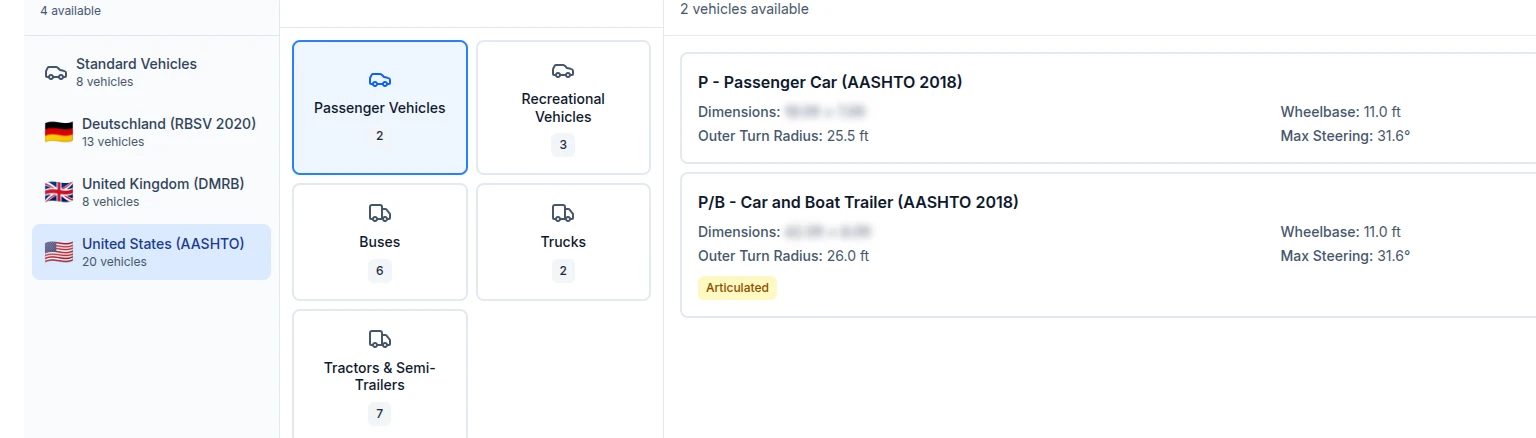
PathSweeper's US vehicle set covers the AASHTO design-vehicle classes (P, SU-30, BUS-40, WB-62, WB-67 and more), with dimensions displayed in US customary units (feet). The values are derived from public sources (state DOT publications and manufacturer data); factual vehicle dimensions are not copyrightable. Each vehicle's turning behaviour is cross-checked against an independent swept-path engine (AutoTURN Online) so the envelopes agree with established templates. PathSweeper does not redistribute the AASHTO Green Book text or its tables, and this is not a claim of AASHTO certification.
The standard vehicle library is free. The US design-vehicle set is unlocked with the Projekt Pass, a one-time per-project unlock (no subscription). You can draw a path and see the swept envelope for free before deciding.
Conclusion
The AASHTO Green Book is the authoritative reference for US geometric design, and unlike the MUTCD it is not free: AASHTO is a private standards body, and federal incorporation by reference (23 CFR 625.4) does not place the Green Book in the public domain. For federal-aid and state DOT submissions you will need the official Green Book, or a CAD package that ships AASHTO-derived vehicles. For private pre-design and feasibility, the combination of the federal STAA limits (23 CFR 658), free state DOT manuals and public manufacturer data is usually sufficient. And whichever route you take, remember the code convention: SU and BUS numbers are overall length, WB numbers are wheelbase.
Related guides
- Swept-Path Analysis: The Complete Guide for Planners, Ackermann steering geometry, vehicle parameters and how swept-path envelopes are computed.
- UK Design Vehicles: DB32, DMRB and Manual for Streets, the UK counterpart, where the primary standards are mostly free.
- RBSV 2020 Design Vehicles (Germany), the German counterpart, and where the "85th-percentile" framing comes from.
PathSweeper's US vehicle set uses dimensions from public sources and is cross-checked against independent swept-path software. It is not affiliated with or endorsed by AASHTO, and is not a claim of AASHTO compliance. Try it free.
Spotted a factual or regulatory error in this guide? US standards practice varies by state, and corrections from US transportation engineers are very welcome via the in-app feedback button.