UK Design Vehicles for Swept-Path Work: DB32 Turning Circles, DMRB and Manual for Streets

When a highway officer conditions your planning application on a swept-path check, the first question is which document they will cite: DB32 turning circles for a residential scheme, DMRB for the Strategic Road Network, Manual for Streets for local streets, or the FTA design vehicles for freight and servicing access. This guide maps the UK reference documents, where to get each one (most are free PDF downloads), and which design vehicles they actually define. If you are working on a UK project from abroad, everything here applies equally; the UK regime is unusually accessible from anywhere.
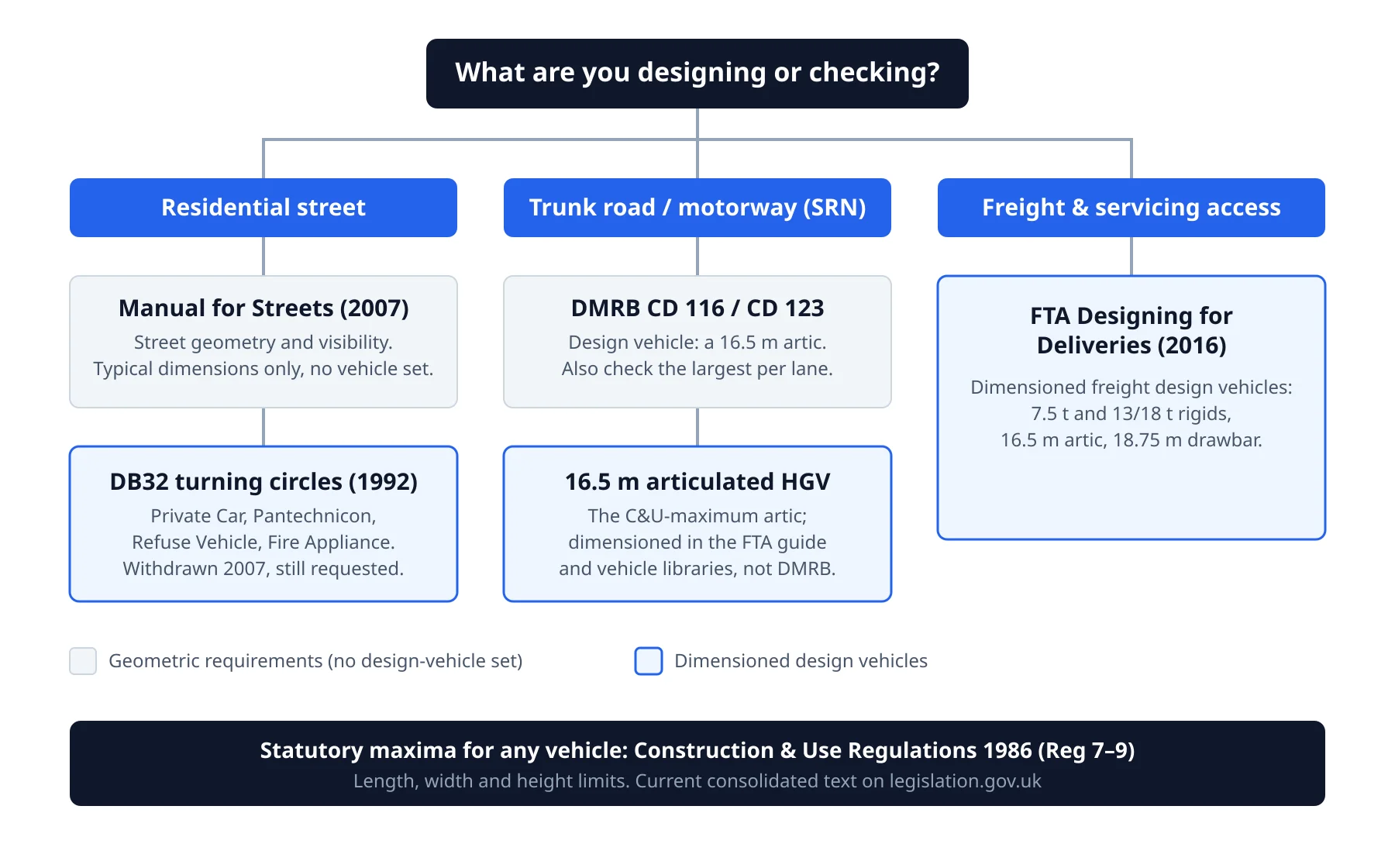
In short: UK swept-path checks typically run on the DB32 turning circles (1992) for residential vehicle templates, DMRB CD 116 / CD 123 for the Strategic Road Network, Manual for Streets for local streets, and the FTA's Designing for Deliveries (2016) for freight vehicles. DMRB and Manual for Streets are free downloads, but neither publishes a design-vehicle catalogue (MfS shows only typical dimensions): the dimensioned sets come from DB32 (withdrawn 2007, still requested) and the FTA guide. Statutory maxima sit in the Construction and Use Regulations 1986.
What are UK design vehicles?
Like elsewhere in Europe, UK road design uses standardised "design vehicles": conservative reference vehicles whose dimensions and turning behaviour planners use in swept-path analysis to verify that geometric layouts (roundabouts, junctions, residential street bends, service yards) can actually be driven by the heaviest realistic traffic. But here is the detail that trips people up: neither of the UK's live official standards publishes a design-vehicle set. DMRB CD 116 and CD 123 name their standard design vehicle, a 16.5m articulated HGV, in a single glossary line with no dimension table behind it, and both require checking the largest vehicle actually expected in each lane (CD 116 uses a 15.5m variant for its turning-width tables; CD 123 calls up a drawbar vehicle where long vehicles are expected). Manual for Streets shows only typical bus and car dimensions (Figures 6.16 and 6.18) and quotes BS 5906 for waste vehicles; it contains no named design-vehicle set with turning geometry. The dimensioned vehicle sets UK practice actually runs swept-path checks with both sit outside the current official canon: the DB32 turning circles come from a design bulletin withdrawn in 2007, and the FTA's Designing for Deliveries (2016) is a private industry guide, not a government standard. Statutory maxima are fixed by the Construction and Use Regulations 1986.
A design vehicle is not a real vehicle type. It is a deliberately worst-case envelope that the design profession agrees to plan against, so that real fleet variation is covered.
Typical UK design vehicle dimensions (public sources only)
The table below is not a reproduction of any single official dataset. It combines the statutory maxima from the Construction and Use Regulations 1986 with manufacturer datasheet values. For preliminary design and feasibility this is usually sufficient; for tendered work you should always cross-check against the specific design vehicle named in the project brief.
| Vehicle | Length (m) | Width (m) | Wheelbase (m) | Notes |
|---|---|---|---|---|
| Passenger car (typical) | 4.7 – 4.9 | 1.85 | 2.7 – 2.9 | Manufacturer data |
| Light goods vehicle (Sprinter class) | 6.5 – 7.0 | 2.20 | 3.8 – 4.3 | Manufacturer data |
| Rigid lorry, 2-axle | up to 12.00 | 2.55 | 5.0 – 6.0 | C&U Reg 7 maximum length 12.00 m |
| Rigid lorry, 3-axle | up to 12.00 | 2.55 | 5.4 – 6.0 | C&U Reg 7 maximum |
| Refuse collection vehicle (26 t) | 9 – 11 | 2.55 | 4.0 – 5.7 | Mercedes Econic / Dennis Eagle build data |
| Single-deck bus 12 m | up to 12.00 | 2.55 | 5.8 – 6.0 | Manufacturer data |
| Double-deck bus | 10.4 – 11.5 | 2.55 | 5.5 – 6.0 | Manufacturer data |
| Articulated lorry (semi-trailer) | up to 16.50 | 2.55 | 3.8 + 7.7 – 8.15 | Common UK artic length is 16.50 m |
| Drawbar vehicle (rigid + trailer) | up to 18.75 | 2.55 | varies | C&U combination length |
All values from publicly available sources: Construction and Use Regulations 1986 and manufacturer datasheets. They are not a reproduction of any specific official design-vehicle catalogue and are presented without warranty. Always verify the design vehicle named in your project brief against the original source.
Good news: DMRB and Manual for Streets are free PDFs
Easy to take for granted if you work in the UK, remarkable by international standards: in Germany, the FGSV's RBSV 2020 design-vehicle catalogue is paywalled at €52 and cannot be republished, and several other European jurisdictions are similar. The AASHTO Green Book behind US practice is a paid publication as well, while Australia's Austroads templates are a free download like the UK's. The UK primary sources, by contrast:
- DMRB CD 116 and CD 123 (and indeed the entire DMRB) are published as free PDFs, with no registration and no payment, by Standards for Highways at standardsforhighways.co.uk/dmrb.
- Manual for Streets (2007) is a free PDF on gov.uk, published originally by the Department for Transport.
- The legacy TD-series documents (TD 16/07, TD 42/95 etc.), which are still cited in older drawings and reports, are also publicly retrievable as free PDFs, though most have been superseded by the current CD documents.
For the vast majority of swept-path work, the primary sources are legitimately downloadable in full, wherever you are working from.
Which UK swept-path documents are paid?
The notable paid item is Manual for Streets 2: Wider Application of the Principles (CIHT, 2010), which extends MfS principles beyond pure residential streets into busier urban contexts. It is published by the Chartered Institution of Highways and Transportation (CIHT). Per the CIHT announcement: £20 + VAT read-only PDF (single user) / £150 + VAT high-resolution intranet PDF licence; the print edition is still sold but the price is not listed publicly. Contact publications@ciht.org.uk. Verify current pricing on the CIHT site before quoting it to a client.
Note also: a Manual for Streets 3 has been in closed DfT consultation through late 2025 / early 2026: Part B closed on 22 January 2026 and Part C was circulated to selected practitioners on 23 January 2026. As of July 2026 MfS3 is not yet published and CIHT states that no publication date has been announced; until it appears, MfS (2007) and MfS2 (2010) remain the live references. CIHT's status page: Revising Manual for Streets.
Other potentially paid items:
- AutoTURN and other CAD swept-path packages (commercial; UK-specific vehicle libraries included).
- Specialist CIHT, IHE and TRL technical publications.
- Local authority design guides published commercially.
Practical legal compendium for swept-path work in the UK
| Document | Scope | Status | Free? |
|---|---|---|---|
| DMRB CD 116 (v2.1.0, May 2023) | Roundabouts on Strategic Road Network | Current | Yes |
| DMRB CD 123 (v2.1.0, Nov 2021) | At-grade priority & signal-controlled junctions on SRN | Current | Yes |
| Manual for Streets (DfT, 2007) | Residential / lightly-trafficked streets | Current | Yes |
| Manual for Streets 2 (CIHT, 2010) | Wider application of MfS principles | Current | Paid (CIHT) |
| Construction & Use Regs 1986 (Reg 7–9) | Statutory max length / width / height | Current (consolidated) | Yes |
| TD 16/07, TD 41/95, TD 42/95 etc. | Legacy DMRB, still cited | Withdrawn / superseded | Yes (archive) |
DMRB vs. Manual for Streets: which one applies?
The boundary that decides which rulebook your checker opens:
- DMRB is the National Highways standard for the Strategic Road Network: motorways and trunk roads. In Scotland, Wales and Northern Ireland the equivalent overseeing organisations adopt DMRB with national overlays.
- Manual for Streets governs residential streets and lightly-trafficked local roads: the day-to-day domain of housing developers and local highway authorities.
- For local authority roads that fall between the two (busy urban distributors, town-centre streets), MfS2 explicitly extends MfS thinking, but local design guides also frequently apply.
If you are planning a service yard, a supermarket access, or a residential turning head, the relevant reference is almost always Manual for Streets, not DMRB. If you are designing a slip road or a trunk-road roundabout, it is DMRB CD 116 / CD 123.
Which UK design standard should you use?
| Situation | Primary reference |
|---|---|
| Roundabout on a trunk road or motorway | DMRB CD 116 |
| Priority / signal junction on a trunk road | DMRB CD 123 |
| Residential street, cul-de-sac, housing access | Manual for Streets (2007) |
| Mixed-use urban street with through traffic | MfS2 (2010), plus local guidance |
| Statutory absolute maxima (any vehicle type) | C&U Regs 1986, Reg 7–9 |
| Swept-path simulation | PathSweeper (browser, DB32 + FTA 2016, articulated and custom vehicles, one-time per project), or AutoTURN, Vehicle Tracking, OpenRoads (annual CAD seats) |
DB32 turning circles: still the residential benchmark
For residential schemes, the design vehicles your checker is most likely to name do not come from DMRB or Manual for Streets at all. They come from Design Bulletin 32 "Residential Roads and Footpaths" (DoE/DoT, 2nd edition 1992), whose appendix published turning-circle templates for four vehicles:
- Private Car
- Pantechnicon (removals van, the classic worst case for a residential street)
- Refuse Vehicle
- Fire Appliance
DB32 was withdrawn in 2007 when Manual for Streets replaced it (MfS states this in its own introduction), but MfS never published a replacement vehicle set. The profession simply kept using the DB32 turning circles: Birmingham's Highways Developers Guide, updated August 2024, still directs turning-area design to "the (now superseded) 1:200 diagrams in Appendix 1 of Design Bulletin 32", and it is far from alone. Two things are worth knowing when you use them:
- The templates are a 1992 baseline, not a current fleet: Manual for Streets itself quotes BS 5906:2005 putting the largest waste vehicles at around 11.6m with a 20.3m turning circle, against DB32's 7.7 to 7.9m refuse vehicle. Many authorities' own design guides therefore ask for a current refuse or fire vehicle in addition to the DB32 check.
- The 1992 appendix published drawn templates, not a precise dimension table. Published digitizations of the DB32 vehicles consequently differ by up to 0.6m in overall length between sources, while wheelbase, track and turning geometry are consistent. Whichever tool you use, check which digitization it carries.
UK design vehicles in PathSweeper
PathSweeper computes the swept path in your browser with realistic vehicle kinematics: true Ackermann steering for rigid vehicles and full tractor-trailer articulation for combinations, the same engine on every vehicle. No CAD licence, no install, no plotting a template by hand.
The vehicle selector includes two UK sets, chosen because they are the ones UK planning submissions actually reference:
- The four DB32 turning-circle vehicles for residential streets (see the section above). PathSweeper documents which digitization it uses in the in-app source notes.
- FTA "Designing for Deliveries" (2016) design vehicles for freight access, as implemented across the major swept-path vehicle libraries: the 7.5 tonne rigid, the 13/18 tonne rigid, the 16.5m articulated vehicle and the 18.75m FTA Design Drawbar Vehicle.
The four generic Standard vehicles (car, van, rigid truck, bus) and the full swept-path engine are free to use. The UK libraries above, plus the custom vehicle creator, unlock with a one-time Project Pass. The creator matters for real UK work because checks routinely call for a vehicle no fixed library carries: a current 11m refuse collection vehicle rather than DB32's 1992 one, a specific fire appliance, or a servicing vehicle agreed with the local authority. Enter its wheelbase, overhangs and steering lock, run the swept path, and export the result as DXF or DWG with measurements for the submission. The click-by-click steps, with a UK aside on the refuse vehicle, are in our swept path diagram tutorial.
And it is a one-time cost, per project, not a subscription. Where desktop swept-path packages are licensed by the year, a Project Pass is a single per-project charge with an invoice you can pass straight through to the client.
Longer Semi-Trailers (LSTs, legal in Great Britain since 31 May 2023) are deliberately not included: the 2023 regulations set only maxima (18.55m combination, 15.65m trailer) and no official design-vehicle template exists. Where a tool offers an "LST design vehicle", it is that vendor's own construction, not a published standard. If you need one, the custom vehicle creator builds it to your exact trailer length and axle positions.
Swept-path tools with UK vehicle libraries
- PathSweeper: browser-based, no CAD licence and no install. Ships both UK sets, the DB32 (1992) turning-circle vehicles and the FTA Designing for Deliveries (2016) set, with full articulated-vehicle kinematics and a custom vehicle creator for anything a fixed library omits. Draw the turn, read the swept path, and export DXF or DWG with dimensions. It is a one-time unlock per project, with an annual plan for regular use, rather than a per-seat annual licence, which makes it the cost-effective choice whether you run a single check or work on swept paths every week.
- AutoTURN / AutoTURN Pro (Transoft Solutions): ships a free UK Common Vehicles Library add-on for UK and Ireland users on top of its 1,800-strong standard library; integrates with AutoCAD, Civil 3D and MicroStation. Licensed as an annual CAD seat; the list prices of its browser edition are collected in our AutoTURN Online pricing breakdown.
- Autodesk Vehicle Tracking and AutoCAD Civil 3D Country Kits: UK vehicles are included historically, but contents shift between versions; verify the exact library with Autodesk for the release you operate. Licensed as an annual CAD seat (compared with PathSweeper).
- Bentley OpenRoads Designer: UK templates available; verify with Bentley.
If you need a specific named vehicle (e.g. "16.5 m artic per CD 116 Appendix"), check that the package you license actually maps to that source. Vendors sometimes ship generic vehicles labelled as if they came from a national standard.
Brexit footnote
Post-Brexit the UK has retained the Construction and Use Regulations 1986 as live domestic law and continues to track closely to EU vehicle dimensions in practice. Where divergence matters (longer semi-trailers, longer combinations, alternative-fuel allowances) the C&U Regs as consolidated on legislation.gov.uk are the authoritative text. Always use the current consolidated version, not the 1986 "as enacted" snapshot.
Conclusion
The UK swept-path regime is unusually accessible: the headline references are free PDFs, the statutory backstop is public legislation, and the only meaningful paywall (MfS2) is optional for most residential and trunk-road work. The hard part is not access but knowing which document applies (DB32 turning circles and Manual for Streets for residential and local streets, DMRB for the Strategic Road Network) and verifying the specific design vehicle named in your project brief against the live source.
Related Guides
- RBSV 2020 Design Vehicles: Sources and Alternatives: the German equivalent, including why RBSV is paywalled and how the StVZO public alternative works.
- Swept Path Analysis: The Complete Guide for Planners: Ackermann steering geometry and the underlying maths shared by all national catalogues.
PathSweeper is a German-built swept-path SaaS used internationally. Its UK catalogue ships the DB32 (1992) template vehicles and the FTA Designing for Deliveries (2016) design vehicles, with sources documented in-app. Try it free.