Austroads Design Vehicles (Australia): Free Sources for Swept-Path Work

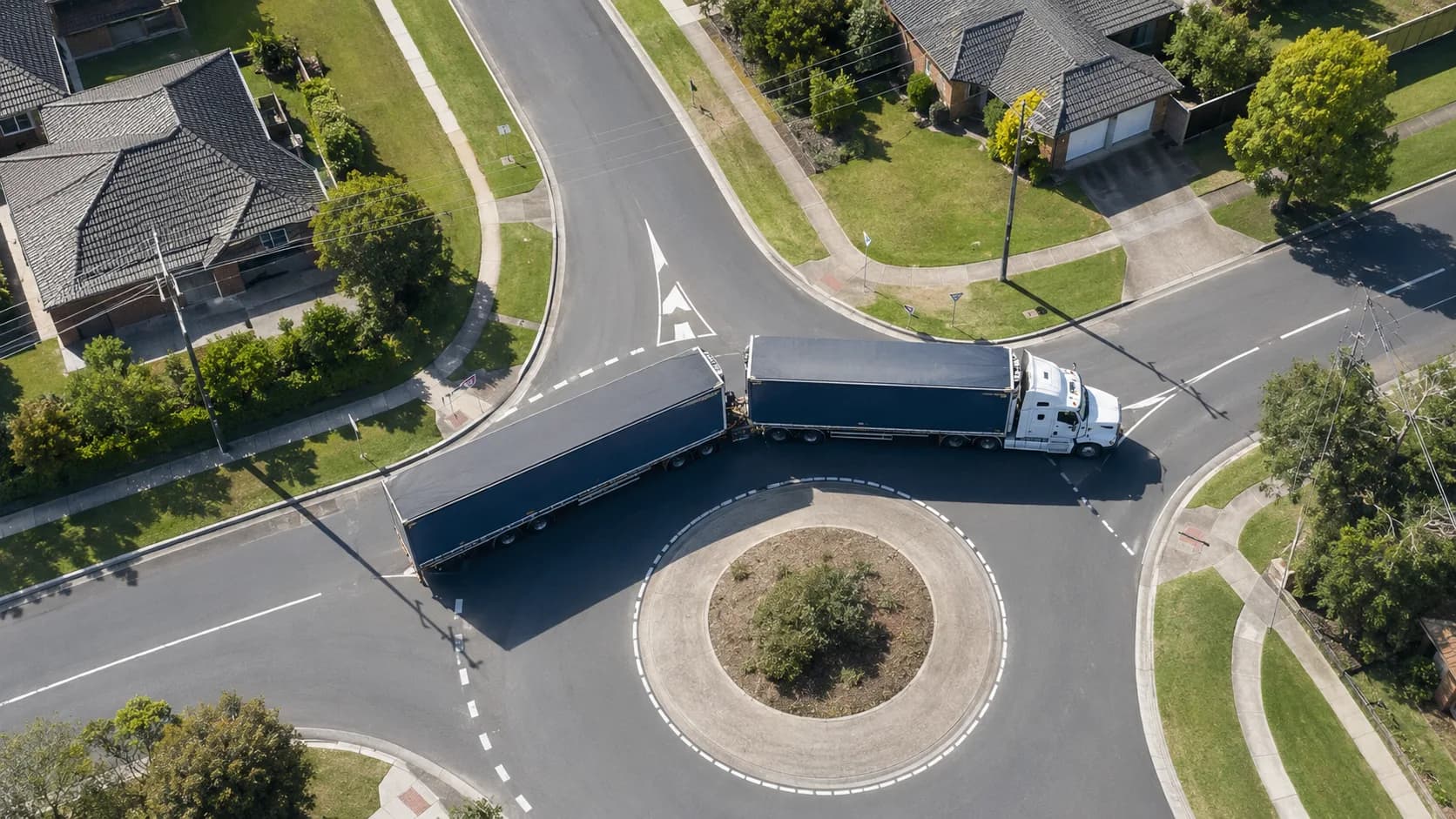
The Austroads design-vehicle suite is the reference set Australian civil and traffic engineers use to size intersections, roundabouts, parking layouts and access geometry. This guide explains what those vehicles are and where to get every figure legally — and the good news, unusual for national design standards, is that the primary source is a free download. Every value below links to the exact page where it lives, so you can verify it yourself.
What are Austroads design vehicles?
An Austroads design vehicle is a standardised reference vehicle whose dimensions and minimum turning path are used to derive geometric design controls. It is a deliberately conservative envelope the profession agrees to plan against, not a specific real-world make. The canonical source, Austroads AP-G34 — Design Vehicles and Turning Path Templates, defines the set and — per its own product page — provides "a series of turning path (swept path) templates for a range of design and checking vehicles from passenger cars, single unit trucks and buses, to articulated and multiple-combination vehicles, such as B-doubles and road trains."
The heavy configurations and their reference lengths, taken directly from the free AP-G34 page:
- Passenger car — B85 (85th-percentile car) and B99 (large car / SUV), defined in AS/NZS 2890.1 (see below).
- Single-unit truck and bus — the rigid service / refuse / route vehicle.
- Articulated bus — for transit corridors and interchanges.
- Prime mover + semi-trailer — 19 m — the basic articulated freight vehicle for general urban access.
- Prime mover + long semi-trailer — 25 m — longer semis on permitted networks.
- B-double — 25 m and 26 m — the dominant interstate articulated freight configuration.
- B-triple — 35.4 m.
- A-double / Type I road train — 36.2 m (AP-G34 notes the maximum permitted length is 36.5 m; 36.2 m reflects typical dimensions).
- A-triple / Type II road train — 53.4 m (maximum permitted 53.5 m).
The geometric-design guidance that consumes those templates is Austroads AGRD03 — Guide to Road Design, Part 3: Geometric Design (Edition 3.4, 26 February 2021), which lists "design vehicles" among its core design parameters (§2.2.7).
Statutory dimensions are public (via the NHVR)
Design-vehicle statutory limits — the maxima a real vehicle may not exceed — are public, published by the National Heavy Vehicle Regulator under the Heavy Vehicle National Law's Mass, Dimension and Loading Regulation:
| Dimension | General limit | Source (exact page) |
|---|---|---|
| Width | 2.5 m | nhvr.gov.au — width |
| Height | 4.3 m (double-decker bus 4.4 m; livestock / 2-deck vehicle carrier 4.6 m) | nhvr.gov.au — height |
| Rigid truck | 12.5 m | nhvr.gov.au — length |
| Articulated (prime mover + semi) | 19 m (see note) | nhvr.gov.au — length |
| B-double | 25 m (up to 26 m under conditions) | nhvr.gov.au — length |
| Bus (rigid / articulated) | 14.5 m / 18 m | nhvr.gov.au — length |
| Road train | 53.5 m | nhvr.gov.au — length |
Time-sensitive note: the length limit for a prime-mover-plus-semi-trailer combination is scheduled to change (from 19 m) around 1 August 2026 under pending amendments. If you are reading this near or after that date, confirm the current figure on the NHVR length page before relying on 19 m.
Two more public NHVR facts worth knowing:
- Where the law applies. The NHVR states it administers the HVNL, "which applies in all Australia's states and territories except the Northern Territory and Western Australia" (About the NHVR). WA and NT run their own heavy-vehicle regimes — relevant if your project is in Perth or Darwin.
- Beyond the general limits: PBS. Vehicles exceeding the prescriptive limits can operate under the Performance Based Standards scheme, assessed against "16 minimum vehicle performance standards and 4 infrastructure protection standards" across four access levels. PBS is where innovative long/heavy combinations get their swept-path envelopes signed off.
Good news: the Austroads templates are a free download
This is the crucial bit, and it corrects a common misconception. Unlike the US AASHTO Green Book (paid) or Germany's RBSV 2020 (paid, €52), the Austroads design-vehicle templates are published free of charge:
- AP-G34 is Edition 4.0, published 29 May 2023 (ISBN 978-1-922700-89-6), and is listed on its own product page as "PDF (free)".
- The design-vehicle dimensions and drawings download as a PNG + PDF zip; the turning templates download as DWG (AutoCAD 2010) + PDF. Edition 4.0 added guidance on design versus checking vehicles, performance-based-standards vehicles, clearances between swept paths, software parameters, and a new car-plus-trailer design vehicle.
One important caveat: free to download is not the same as open licence. Austroads content remains copyrighted — per the Austroads Terms of Use, no material "may be reproduced, stored in an electronic or other retrieval system, adapted, uploaded to a third party location, framed, performed in public or transmitted in any form … without the specific written consent of Austroads." So you may download and use AP-G34 for your project, but you may not republish its dimension tables on the open web. (That is also why this guide links to the source rather than reproducing the tables.)
Is Austroads a government agency?
No. The About Austroads page describes it as "the association of the Australian and New Zealand transport agencies" and "a not-for-profit, nonpartisan organisation." Its members are the state and territory road/transport agencies (Transport for NSW; Department of Transport and Planning Victoria; Queensland TMR; Main Roads WA; SA Department for Infrastructure and Transport; Building Tasmania; NT Department of Logistics and Infrastructure; the ACT City and Environment Directorate), the Commonwealth transport department, the Australian Local Government Association, and NZ Transport Agency Waka Kotahi.
So Austroads is a member association, not a Crown body — but, unlike AASHTO, it makes its guides freely downloadable. Incorporation of Austroads guidance into a state design manual does not change the copyright on the underlying text.
What actually costs money: the AS 2890 series
The genuinely paywalled documents on an Australian project are Standards Australia parking-facilities standards, which are separate from Austroads:
- AS 2890.2:2018 — Parking facilities — Off-street commercial vehicle facilities (published 21 December 2018, ISBN 978 1 76072 340 8) — the reference for loading docks, service-vehicle access and commercial-vehicle manoeuvring on private property. Its scope: "minimum requirements for the layout of off-street facilities for the loading and unloading of commercial vehicles, including … access driveways across the property boundary and … internal circulation roadways."
- AS/NZS 2890.1:2004 — Parking facilities — Off-street parking — the car-park standard that defines the B85 and B99 design cars.
Both are sold under a single-user, non-transferable licence and may not be republished — per the Standards Australia store terms, the customer receives only "a single user, non-transferable, non-sublicensable, non-exclusive, limited licence." You typically need AS 2890.2 when a council development application explicitly requires AS 2890 compliance for loading bays, service access or refuse-truck turning.
Free state supplements you can legally use
Each state road authority publishes its own supplement to AGRD03, adopting Austroads guidance with local variations. These are Crown-published, free to read, and useful for pre-design — verify the licence on each before redistributing:
- Queensland TMR — Road Planning and Design Manual, Ed. 2, Vol. 3, Part 3: Geometric Design (July 2025). Notably released under CC BY 4.0 — the most openly licensed of the four. It states TMR "has, in principle, agreed to adopt the standards published in the Austroads Guide to Road Design (2021) Part 3."
- Main Roads WA — Supplement to the Austroads Guide to Road Design, Part 3: Geometric Design (June 2026), with a Design Vehicle section under Fundamental Considerations.
- Transport for NSW — TS 02642 Supplement to Austroads Guide to Road Design (issued 20 December 2023), on the Transport for NSW standards portal.
- VicRoads / DoT Victoria — DoT Supplement to AGRD Part 3 (v5.0), via the VicRoads road-design technical publications page. (This document is real and indexed, but the vicroads.vic.gov.au domain blocks automated access; open it in a browser to retrieve the PDF.)
These supplements adopt Austroads' design-vehicle framework and defer the actual dimension tables to AP-G34 — which, being free, you can simply download alongside them.
The B85 and B99 design cars
The passenger-car design vehicles come from AS/NZS 2890.1:2004 (paid). Because that standard is copyrighted, the exact table cannot be republished — but individual figures are freely restated by Australian councils and engineering practices. Commonly cited values (2004 edition):
- B85 (85th-percentile car): 4.91 m × 1.87 m overall.
- B99 (99th-percentile car): 5.20 m × 1.94 m overall.
These figures are restated in public sources such as an Australian engineering practice's B85/B99 explainer and a Moyne Shire Council development document (which lists the "B99 Vehicle … Overall Length 5.200 m"). Note that a later draft revision of AS/NZS 2890.1 increases the B99 envelope — confirm the edition your council requires before using these numbers.
Who governs what — a quick reference
| Situation | What you need |
|---|---|
| Certified intersection / roundabout design for a state road authority | AP-G34 (free) + the relevant state AGRD03 supplement |
| B-double or road-train access verification | AP-G34 templates + NHVR access networks / PBS |
| Loading dock, service access, refuse-truck turning on private property | AS 2890.2:2018 (paid, Standards Australia) |
| Car-park layout | AS/NZS 2890.1 (paid) — B85/B99 |
| Private-side pre-design / feasibility ("will it fit?") | Free AP-G34 + public NHVR limits + manufacturer datasheets |
| Project in WA or NT | State heavy-vehicle regime, not the HVNL |
Where Austroads design vehicles are used in practice
- Intersection and roundabout geometry (turning-path templates)
- Rural and urban road cross-section and alignment design
- Freight-corridor and heavy-vehicle-access planning (B-doubles, road trains, PBS)
- Bus stop, bus bay and interchange design
- Driveway, loading-dock and site-plan review (with AS 2890 on private property)
- Waste-collection and emergency-vehicle access checks
PathSweeper for AU pre-design
PathSweeper produces swept-path geometry from publicly available vehicle dimensions — useful for rapid feasibility, sketch design and "will this fit?" checks. Because Austroads AP-G34 is a free download, it is easy to cross-check PathSweeper's output against the official templates for the same configuration. PathSweeper's geometry is for engineering review; it is not a substitute for AP-G34, and PathSweeper does not claim compliance with Austroads. Engineers verify the output against the reference standards required by their project.
Related Guides
- AASHTO Green Book Design Vehicles: Sources and Alternatives (USA) — the US counterpart, where the reference document is paid rather than free.
- UK Design Vehicles (DMRB & Manual for Streets) — the other major English-speaking regime where the core standards are free downloads.
- RBSV 2020 Design Vehicles: Sources and Alternatives (Germany) — the European sister topic, where the design-vehicle guideline is paywalled.
PathSweeper ships with Austroads-based AU design vehicles (B-doubles and road trains) built from publicly available dimensions. Figures in this guide are drawn from the linked public sources and are provided for pre-design without guarantee — verify against the current standards for certified work.
Spotted a factual or regulatory error? Australian practice varies by state, and heavy-vehicle limits change — corrections from AU transport engineers are very welcome via the in-app feedback button.