Garbage Truck Dimensions: How to Find Binding Values by Country

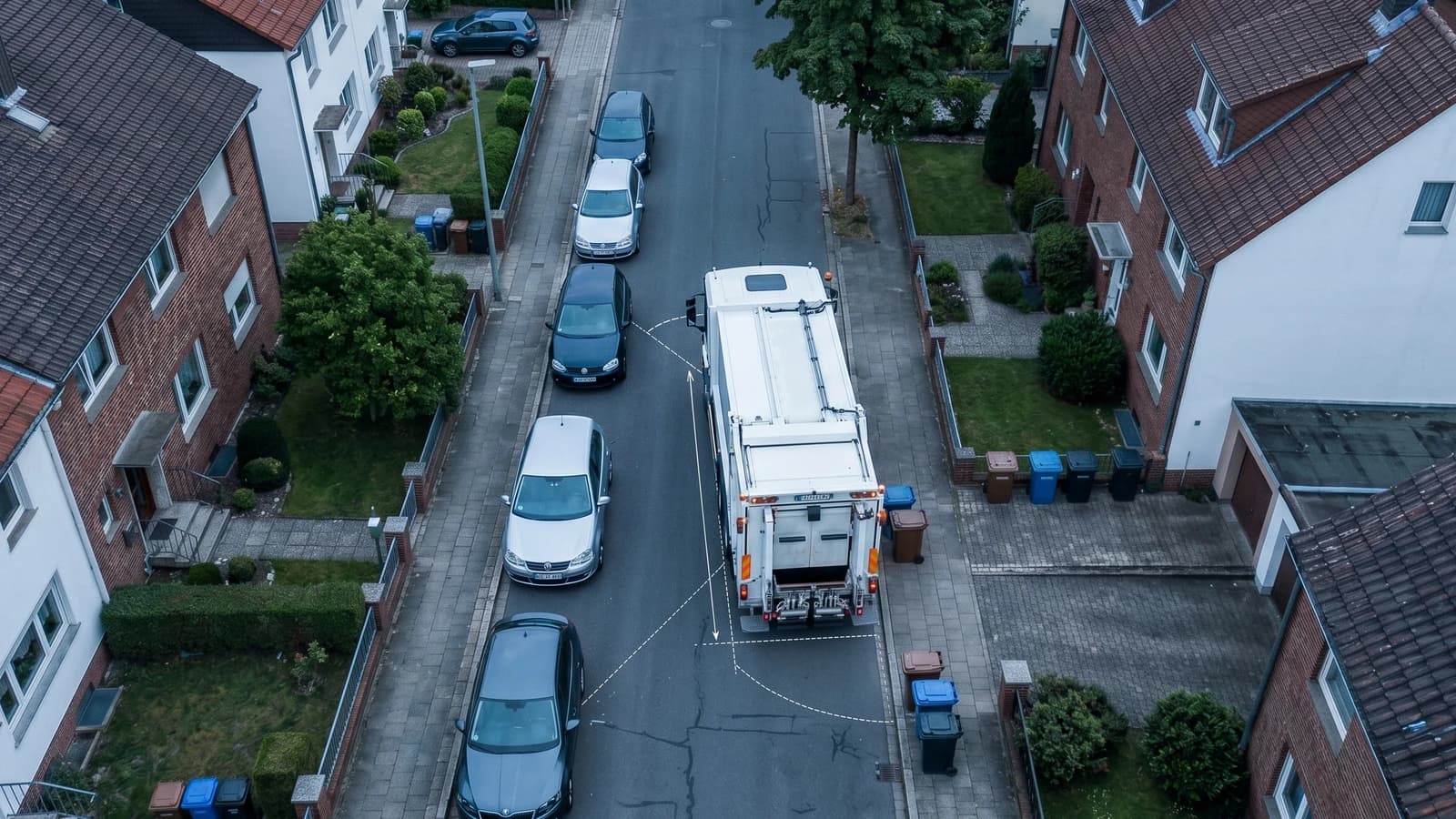
If you are designing access roads, dead-ends or housing estates anywhere in the English-speaking world, sooner or later you face the question: how big is a garbage truck, and how tight can a driveway be before the waste contractor refuses to drive in? The honest answer is that the binding value depends on which country you are submitting in and what the local waste contractor actually drives. This article explains where to find legally usable dimensions in each major jurisdiction, without republishing copyrighted design-vehicle tables.
Manufacturer datasheets (rough estimates)
The values below come from publicly available manufacturer datasheets and bodybuilder guidelines. Because each chassis is offered in numerous wheelbase variants, dimensions are given as ranges; the actual measurements depend on wheelbase and body configuration. Manufacturer specifications are facts about commercial products, free to cite with attribution, and the safest source for pre-design and feasibility values in any jurisdiction.
| Property | Mercedes Econic 1830 (4×2) | MAN TGM 18.290 (4×2) | Volvo FE (4×2) |
|---|---|---|---|
| Wheelbase | 3,450 to 5,700 mm | 4,425 to 6,975 mm | 3,500 to 6,800 mm |
| Front overhang | n/a | 1,400 mm | n/a |
| Rear overhang (chassis) | n/a | 2,325 to 3,275 mm | 2,040 mm |
| Overall chassis length | n/a | n/a | 7,366 to 10,266 mm |
| Turning circle curb-to-curb | 14.8 to 22.0 m | 15.4 to 23.1 m | 12.8 to 23.0 m |
| Turning circle wall-to-wall | n/a | 16.9 to 24.6 m | 14.2 to 24.4 m |
| Vehicle width (cab) | 2,280 mm | 2,488 mm | 2,500 mm |
| GVW | 18.0 t | 18.0 t | 18.0 t |
Sources: Mercedes-Benz Special Trucks Econic datasheet (July 2019); MAN TGM 18T 4×2 Rigid Chassis Specification (May 2022); Volvo STPI Model Range FE 42 R E (Feb. 2026) and FE 42 R A.
The overall length of a completed garbage truck depends on the chassis plus body (rear loader, side loader, front loader, automated side loader) and typically falls between 8 and 10 m for 2-axle chassis with mid-range wheelbases. Maximum vehicle width is set by the statutory road-traffic code in each country: § 32 StVZO sets it at 2.55 m in Germany. For other jurisdictions consult the linked statutory references in the country sections below.
Three-axle refuse vehicles (e.g. Mercedes Econic 2630 in the 6×2/4 ENA variant, wheelbase 3,450 to 4,800 mm, curb-to-curb turning circle 14.8 to 21.1 m) are the most demanding standard case. For commercial bulk containers or recycling yards a semi-trailer (around 16.5 m) may become the design vehicle. Always ask your local waste contractor up front which chassis they actually run on the route.
For US severe-service chassis (Mack LR, Peterbilt 520, Autocar ACX, Crane Carrier LET, International HV / HX) and UK-only chassis (Dennis Eagle Elite 6), consult the manufacturer's downloadable spec sheet for the configuration in service on your route.
Why we do not republish design-vehicle numbers
Every country that does swept-path planning has a national design-vehicle catalogue. In Germany this is the RBSV 2020, published by the FGSV Verlag for €52. In the US it is the AASHTO Green Book (7th edition, 2018). In the UK it is the Manual for Streets and the DMRB for higher-classification roads. In Australia it is the Austroads Guide to Road Design Part 4A. In Canada it is the TAC Geometric Design Guide for Canadian Roads.
All of these are copyrighted commercial publications. We are not legally allowed to republish their dimension tables, turning templates or design-vehicle envelopes. What we can do, and what this article does, is:
- Link to the canonical source in each jurisdiction so you can buy the official regulation that applies to your project.
- Cite statutory maxima from public-law regulations (federal traffic codes), which are always public domain.
- Cite manufacturer datasheet dimensions, which are facts about commercial products and free to use with attribution.
If you need a binding value for a tender, building application or certified submission, buy the official regulation that applies to your jurisdiction. If you need a defensible pre-design or feasibility value, manufacturer datasheets plus statutory maxima are normally enough.
Why turning radius decides your project
Waste collection providers refuse to drive into roads where their trucks cannot safely turn around. The consequence: residents have to carry bins to the nearest accessible point, or the developer pays for retrofitting after construction. A 5-minute swept path check during planning is dramatically cheaper than rebuilding a turning bay later. In most jurisdictions, garbage truck access is one of the most common reasons building authorities require accessibility verification.
Where to find binding dimensions in your country
United States
- Design-vehicle catalogue (paid publication): the AASHTO Green Book, 7th Edition (2018) lists single-unit truck design vehicles used by most state DOTs as the basis for refuse-vehicle access. State Roadway Design Manuals (e.g. Caltrans, TxDOT, FDOT, PennDOT) reference these directly and often republish their tables.
- Statutory maxima (public domain): 23 CFR Part 658 administered by the Federal Highway Administration sets federal truck size and weight limits, including the 102-inch national maximum width.
- Cul-de-sac and subdivision-street geometry: the ITE Recommended Practice "Guidelines for Residential Subdivision Streets" is the most widely referenced US document. Many counties also publish their own waste-collection access standards through their public works or solid-waste department, which override the ITE recommendation locally.
- Refuse vehicle safety standard: ANSI Z245.1-2017 covers refuse vehicle safety requirements. This is not a dimensions catalogue; it is the document waste contractors reference for operating clearances and safety equipment.
- Common chassis: Mack LR Series, Peterbilt Model 520, Autocar ACX, Crane Carrier LET, International HV / HX. Wheelbase, GVWR and turning radius for the specific configuration you plan for are published in each chassis builder's downloadable spec sheet.
United Kingdom
- Design guidance (official publication / free download depending on document): the Manual for Streets (2007) and Manual for Streets 2 (2010) include refuse vehicle access geometry. For higher-classification roads, the Design Manual for Roads and Bridges (DMRB) applies, with CD 123 the current at-grade junction document. The Chartered Institution of Wastes Management (CIWM) and WRAP also publish refuse-vehicle access checklists referenced by many local planning authorities.
- Statutory maxima (public domain): the Construction and Use Regulations 1986 set maximum vehicle width, length, height and weight. Two-axle refuse vehicles in the UK are typically operated at 26 tonnes GVW under these limits.
- Refuse-vehicle-specific standards: BS EN 1501-1 (rear loaders) and BS EN 1501-3 (side loaders) cover safety. These are operating standards, not dimensions catalogues.
- Common chassis: Mercedes Econic, Dennis Eagle Elite 6, Volvo FE, DAF LF / CF, MAN TGM.
Australia
- Design-vehicle catalogue (paywalled): the Austroads Guide to Road Design Part 4A publishes turning paths for design vehicles. State road authorities (Transport for NSW, VicRoads, TMR Queensland, Main Roads WA, DIT South Australia) reference Austroads directly.
- Statutory maxima (public domain): the Heavy Vehicle National Law, administered by the NHVR, sets dimension limits. Note: the HVNL is undergoing reform in 2026 (length, height and mass changes are being phased in from July and August 2026); always check the NHVR page for current applicability before submitting.
- Refuse container standard: AS 4123 (2024 parts) covers mobile waste containers. This applies to bins, not vehicles, but it is what waste contractors use when specifying bin clearances.
- Local council waste plans: every Australian council publishes its own Waste Management Plan with minimum access requirements. The council plan is normally the controlling document for residential subdivision approval.
- Common chassis: Iveco Acco / Stralis, Mercedes Econic, Hino 500 / 700, Isuzu FYJ / FYH, Volvo FE.
Canada
- Design-vehicle catalogue (paywalled, per-chapter pricing): the TAC Geometric Design Guide for Canadian Roads is the federal-level equivalent of the AASHTO Green Book. Provincial transportation ministries (MTO Ontario, MTQ Quebec, MoTI BC, Alberta Transportation) publish their own design supplements that reference TAC.
- Statutory maxima (public domain): the federal Motor Vehicle Safety Act plus provincial highway traffic acts. Limits vary by province.
- Refuse-vehicle guidance: local municipal by-laws are the controlling document. The Solid Waste Association of North America (SWANA) publishes industry guidance shared with the US.
- Common chassis: the US refuse fleet (Mack LR, Peterbilt 520, International HV) dominates in Canada; some urban operators run European Econic chassis.
Germany and the EU
- Design-vehicle catalogue (€52, official publication): RBSV 2020 (FGSV no. 287) is the binding design-vehicle catalogue for German planning. Republishing the tables is restricted under § 87b UrhG database rights.
- Statutory maxima (public domain): § 32 StVZO for length, width and height, and § 32d StVZO for the BO-Kraftkreis turning-ring requirement. The German federal traffic code sets vehicle width at 2.55 m and the statutory turning ring at outer 12.50 m, inner 5.30 m.
- Common chassis: Mercedes Econic, MAN TGM, Volvo FE, Iveco Eurocargo, DAF CF.
Quick swept-path check (any country)
When you need a feasibility check, not a certified submission, you do not need to buy a national design-vehicle catalogue. Three options:
- CAD tools that ship turning templates: AutoTURN, Autodesk Vehicle Tracking, Bentley OpenRoads Designer, Vehicle Tracking (Civil 3D), Trimble Novapoint. Subscription pricing; the field is compared package by package in our swept path software roundup.
- Browser swept-path tools like PathSweeper: the Free tier ships four standard vehicles (car, truck, bus, van) and is enough for a generic feasibility check. To plan against a specific chassis (a Mack LR, a Dennis Eagle, a Hino 700) take the wheelbase and turning radius from the linked datasheet and enter them in the custom vehicle creator on the Project Pass tier (€39 one-time per project). The country-specific refuse chassis catalogue is on the roadmap; custom-creator is the path until it ships.
- Hand calculation from the Ackermann turning-circle formula plus an offset for body overhang. Reasonable for a single tight point, not for full geometry.
For a certified submission to a US state DOT, a UK highway authority, an Australian council or a German Baurechtsamt, the binding design vehicle in the official regulation for your jurisdiction is required.
Verify access with PathSweeper
PathSweeper computes swept paths for 2- and 3-axle garbage trucks directly in your browser. The Free tier covers a generic refuse chassis using one of the four built-in standard vehicles; for a specific chassis from the datasheet table above, use the custom vehicle creator on Project Pass:
- Upload your site plan or aerial view (PDF, JPG, PNG)
- Calibrate the scale by marking a known measurement
- Free tier: pick one of the four standard vehicles for a generic feasibility check. Project Pass: open the custom vehicle creator and enter the wheelbase, turning radius and track width from the linked manufacturer datasheet
- Trace the planned access route
- Export the result as an image (PNG or JPEG) for submission, or as DXF for the CAD drawing if you started from a DXF/DWG upload
The swept path immediately shows whether tight points, turning bays or curves are passable. For residential pre-design in any jurisdiction, this is usually the complete feasibility check. For certified submission, buy the official design-vehicle catalogue that applies in your jurisdiction.
Related guides
- Turning Bay Design for Dead Ends: geometry and where to find the controlling minimum sizes by jurisdiction.
- Swept Path Analysis: The Complete Guide for Planners: fundamentals, Ackermann geometry and which values you may freely use.
Verify your garbage-truck access with the PathSweeper Free tier: free in the browser, under five minutes. Vehicle dimensions you take from the manufacturer datasheets linked above; the geometry math is built in.