Semi-Trailer Swept Path: Kinematics, Hinge Angle and German Statutory Dimensions

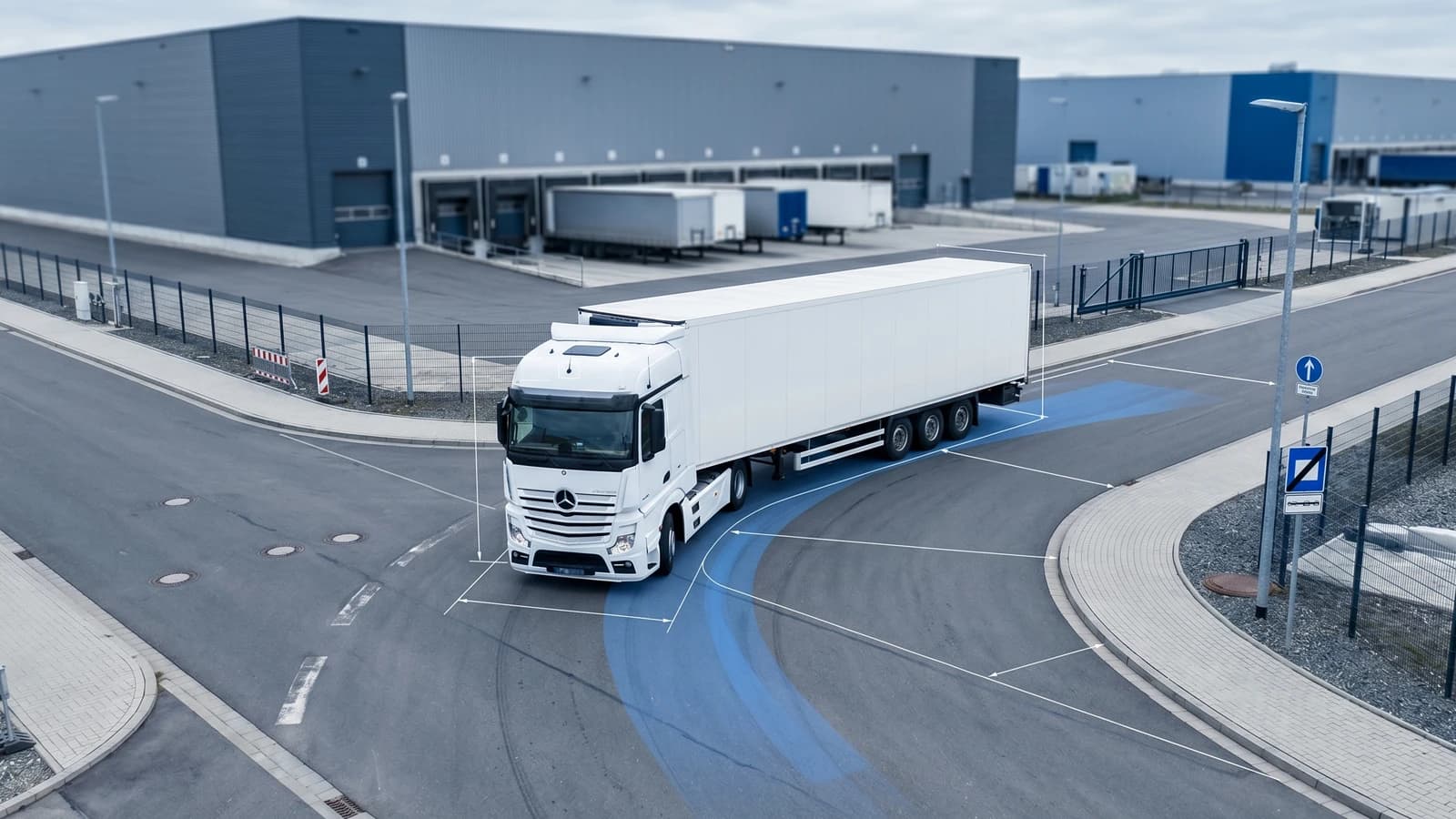
A semi-trailer truck is the most demanding standard vehicle on German roads from a geometry perspective. Unlike a rigid truck, it consists of two articulated parts – tractor unit and trailer – which swing differently through a curve. Anyone planning traffic areas for goods delivery (loading docks, industrial zones, logistics yards) needs a swept path calculation that correctly models this kinematic behavior. This article explains what's different about semi-trailers and which values planners need to know.
Anatomy of a Semi-Trailer
A semi-trailer combination has two parts:
- Tractor unit ("Sattelzugmaschine", SZM) – usually 2 axles with a short wheelbase (3.80 m), about 6.00 m long
- Semi-trailer – 3 axles, mounted on the tractor's fifth wheel via the kingpin; legally up to 13.60 m long
The trailer is connected to the tractor via the fifth wheel and can rotate around the kingpin. Driving straight, both parts are aligned. In a curve, a hinge angle forms between tractor and trailer (up to roughly 75° to 80° depending on the combination).
German Statutory Dimensions (§ 32 StVZO)
Maximum dimensions of a semi-trailer truck on German roads:
| Dimension | Value |
|---|---|
| Total length | 16.50 m |
| Width | 2.55 m (refrigerated 2.60 m) |
| Height | 4.00 m |
| Tractor wheelbase | typically 3.80 m |
| Trailer wheelbase (kingpin → centre of trailer axles) | typically 8.00 – 8.15 m |
| Tractor front overhang | 1.40 m |
| Maximum hinge angle | typically 75 – 80° |
Important: "16.50 m" refers to the total length, not the sum of tractor + trailer. When coupled, the trailer overlaps part of the tractor.
The BO-Kraftkreis per § 32d StVZO also applies to semi-trailers: they must turn within an outer radius of 12.50 m and an inner radius of 5.30 m. In reality they need more space – the rule is just the legal minimum. More on this in the BO-Kraftkreis article.
How a Semi-Trailer Actually Corners: The Kinematics
When a semi-trailer enters a curve, this happens:
- The tractor's front wheels steer and follow the desired path.
- The tractor's rear axle follows a slightly tighter radius (classic Ackermann behavior).
- The tractor rotates around its rear axle, dragging the kingpin along.
- The trailer is pulled via the kingpin. Its rear axles follow an even tighter radius than the tractor's rear axle – this phenomenon is called off-tracking.
Practical consequence: the trailer "cuts" the curve from the inside; it travels inside the tractor's path. In a 90° turn, the difference between the tractor's outer edge and the trailer's inner edge can be up to 3.5 m. This is exactly where trailers collide with curbs, signs, and lampposts in real life. How much space the first metres of the turn take also depends on how quickly the driver can wind on the lock, which is what rate-limited steering models.
Typical Curve Radii for Semi-Trailer Traffic
For planning loading zones, industrial areas, and truck turning areas:
| Situation | Minimum outer radius |
|---|---|
| 90° turn in industrial area | 15.0 m |
| 90° turn with passing traffic | 18.0 m |
| Semi-trailer turning area (full turn) | 30.0 m × 20.0 m |
| Loading zone (reverse-in docking) | 25.0 m × 30.0 m clear |
Exact values depend on the specific design vehicle. For pre-design, feasibility studies and private projects, the rule-of-thumb values above plus a geometric check with a rigid design vehicle are usually a good starting point.
Note on articulated vehicles: Automatic swept-path calculation for semi-trailers and other articulated vehicles (truck and trailer, centre-axle trailer, articulated bus) is available in PathSweeper. The combination is simulated with full articulated kinematics, including articulation-angle monitoring. All articulated vehicle types are covered in the post on articulated vehicle swept paths.
Common Planning Mistakes
- Using car dimensions as a basis – planning a semi-trailer turning area with car swept paths produces something far too small. Factor of 3 – 4 in area.
- Forgetting the trailer tail swing – when entering a turn, the rear of the trailer swings outward before pulling inward. This "tail swing" can be up to 0.8 m and collides with obstacles on the outside of the curve.
- Unrealistic hinge angle assumptions – a semi-trailer cannot bend arbitrarily. Depending on the combination, the trailer mechanically hits its stop at hinge angles of roughly 75° to 80°. Designing for 90° is unrealistic.
- Insufficient bearing capacity – a fully loaded semi-trailer is 40 t total weight. SLW 60 (60 t bearing capacity) should be the minimum for industrial surfaces.
Related Guides
- Swept Path Analysis: The Complete Guide for Planners – Ackermann steering geometry, vehicle parameters and the foundation of every swept path calculation.
- RBSV 2020 Design Vehicles Explained – the reference table of German design vehicles including the semi-trailer.
Automatic swept-path calculation for semi-trailers and other articulated vehicles is available in PathSweeper. The PathSweeper Free tier checks the standard vehicles free in the browser. RBSV 2020 design vehicles including semi-trailer, truck-and-trailer and articulated bus: Project Pass at €39 one-time per project.