BO-Kraftkreis (§ 32d StVZO) Explained: The Free Alternative to RBSV 2020

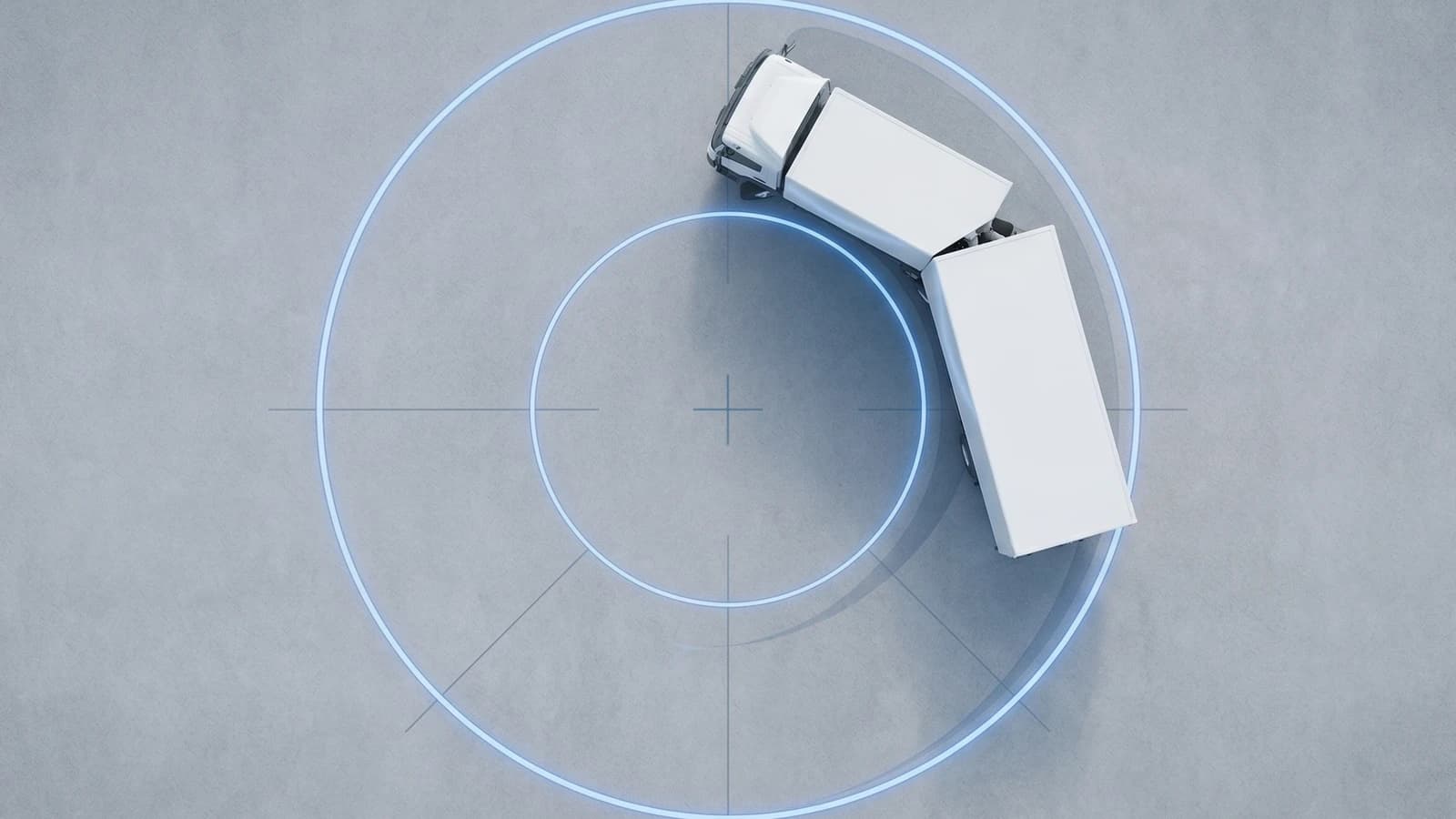
If you want to compute a swept path in Germany without buying the RBSV 2020, your most important legal anchor is the BO-Kraftkreis. The name comes from Betriebsordnungs-Kraftkreis (operating-rules turning circle) and is defined in § 32d of the German road traffic licensing regulation (StVZO). Unlike the RBSV, the StVZO is a federal law and therefore public domain under § 5 UrhG – you may freely cite the values, embed them in CAD tools, and build them into software. This article explains what the BO-Kraftkreis is, where it comes from, and how to use it as a legally safe alternative to the RBSV.
What § 32d StVZO Actually Says
§ 32d (1) StVZO reads (paraphrased): Motor vehicles and vehicle combinations must be constructed such that the area swept while driving in a circle lies between an outer circle of 12.50 m radius and an inner circle of 5.30 m radius.
In plain English: every street-legal vehicle in Germany must be able to turn within an annular ring with an outer radius of 12.50 m and an inner radius of 5.30 m. If it can't, it doesn't get road approval. This applies to passenger cars, trucks, semi-trailers, full trailers, and even special vehicles like garbage trucks or aerial ladders.
| Value | Measurement |
|---|---|
| Outer circle (radius) | 12.50 m |
| Inner circle (radius) | 5.30 m |
| Ring width | 7.20 m |
| Outer circle (diameter) | 25.00 m |
Why This Is a Brilliant Planning Aid
When you don't know which specific vehicle is the design case for your project, you can fall back on the BO-Kraftkreis: anything that's street-legal fits in. The BO-Kraftkreis is the common lower bound – the "smallest common turning capability" of every German road vehicle.
Several useful planning values follow directly:
- Minimum outer-edge curve radius: 12.50 m. If your planned outer carriageway edge has a curve radius ≥ 12.50 m, every street-legal vehicle (car through semi-trailer) can drive the curve – without you knowing the exact swept paths.
- Maximum required worst-case turning circle: 25.00 m. Turning bays must be at least 25 m × 25 m to allow any vehicle to turn in a single move.
- Drivable annular ring: 7.20 m wide. A 90° curve on a two-way carriageway needs corresponding inner/outer edge clearance.
When the BO-Kraftkreis Method Is Enough – and When It Isn't
Enough for:
- Private projects and pre-design
- Feasibility studies and early concepts
- Building applications without an explicit RBSV reference
- Worst-case feasibility checks ("does anything fit at all?")
- Turning-bay and turning-circle sizing
NOT enough for:
- Public tenders that explicitly reference RBSV 2020
- Detailed planning with named design vehicles (e.g. "garbage truck per RBSV 2020")
- Tighter swept paths – the BO-Kraftkreis is a worst-case value, not a specific vehicle curve
- Maneuvering or multi-move turns (only single-circle motion is regulated)
When in doubt: check the building application or tender for references to RBSV 2020, RASt 06 etc. If no specific standard is required, the StVZO values are a legally safe baseline.
Worked Example: A 90° Curve in a Residential Street
You're planning a 90° turn in a residential street. What's the minimum curve radius the garbage truck can handle?
- Minimum outer radius per BO-Kraftkreis: 12.50 m – the absolute legal floor.
- Curb clearance: add 0.5 m safety on each side → effective drivable outer radius must be 13.00 m.
- Inner swept-path radius: for a typical 2-axle garbage truck, about 7.5 m (slightly more than the § 32d value of 5.30 m, because real garbage trucks need a larger inner radius due to their length and rear overhang).
- Minimum carriageway width in the curve: 13.00 m − 7.5 m = 5.50 m → RASt 06 requires widening to at least 5.00 m in comparable situations.
With this quick check you see whether your design can legally work at all – without buying a single regulation.
Related Guides
- Swept Path Analysis: The Complete Guide for Planners – the fundamentals of swept path calculation and Ackermann steering geometry.
- RBSV 2020 Design Vehicles Explained – the three ways to RBSV-conformant design vehicles (original regulation, PathSweeper Project Pass at €39 one-time, or free StVZO values).
Calculate your swept path free in the browser with the PathSweeper Free tier – § 32d-compliant default vehicles included. For RBSV 2020 design vehicles: Project Pass at €39 one-time per project.