Turning Bay Design for Dead-Ends: Variants, Source Standards and Common Mistakes

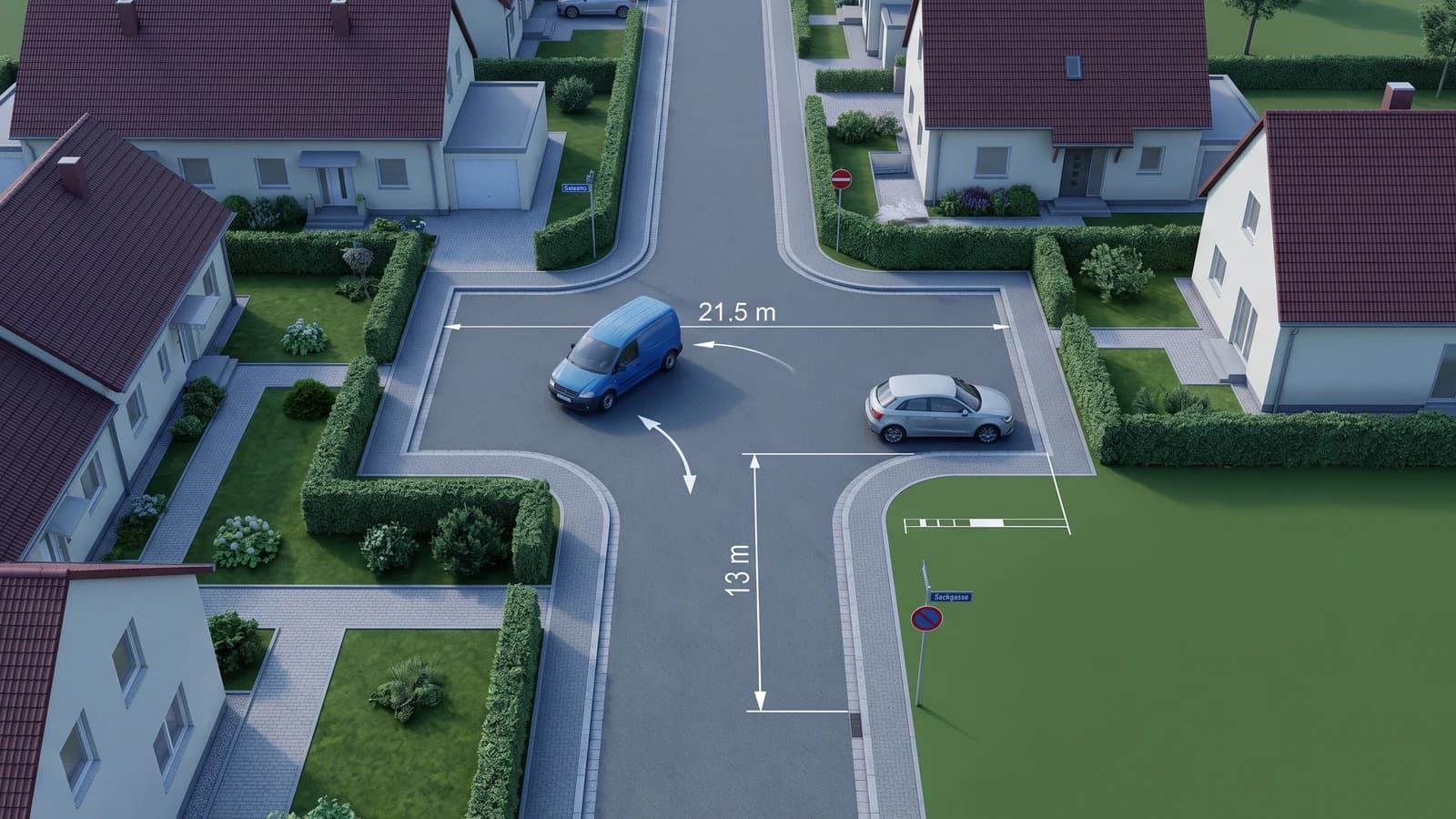
In dead-end streets, garbage trucks, fire apparatus and delivery vehicles must be able to turn around safely. The geometric requirements for turning bays are codified in the Richtlinien für die Anlage von Stadtstraßen (RASt 06) of the FGSV. This article explains the common variants, where the binding values come from, where to source them legally — and which planning mistakes most commonly cause projects to fail.
Where the Turning Bay Dimensions Come From
The exact geometric requirements for turning bays (variants, minimum dimensions, swept-path templates) are defined in the RASt 06 (FGSV no. 200) and the supplementary RBSV 2020 (FGSV no. 287). Both regulations are published by the FGSV Verlag and are copyright-protected. A structured online reproduction of the tables would be unlawful — binding values must be sourced from the original publication.
Three paths to the binding dimensions:
1. Buy the original from the FGSV Verlag. The RASt 06 contains the complete turning-bay dimensions including variant schemata. Required for any certified verification in a public tender. The supplementary RBSV 2020 (€52) supplies the corresponding swept-path templates for design vehicles.
2. Use a tool with RBSV 2020 design vehicles. The PathSweeper Project Pass (€39 one-time per project, no subscription) ships with the design vehicles conforming to RBSV 2020 (with the permission of the FGSV) – currently the cheapest one-time-payment offer on the market. Subscription CAD packages like Autodesk Vehicle Tracking, AutoCAD Civil 3D Country Kit DACH, Bentley OpenRoads, BricsCAD Pro and CARD/1 ship the German design vehicles and turning-bay templates as well.
3. Public-domain official sources for pre-design and feasibility. Federal-state building codes and their administrative regulations provide free values (§ 5 UrhG): the minimum dead-end length that triggers a turning area follows from DIN 14090 in conjunction with the relevant federal-state guideline on fire brigade areas (e.g. the Bavarian Guideline). The maximum reversing distance and safety requirements for refuse vehicles are defined in DGUV Rule 70. The PathSweeper Free tier verifies turning-bay geometry free in the browser with a standard passenger car – sufficient for feasibility studies, pre-design and quick sanity checks.
Variants Overview
Three variants are common in German planning practice:
- Hammerhead turning bay — transverse bar at the dead-end terminus. Standard in new development areas because the garbage truck can maneuver in a single move; the variant accommodates both refuse collection and the fire department's tanker. The practical hammerhead for residential development is widely cited in the literature with outer dimensions around 21.5 m × 13.0 m (quoted from RASt 06 under § 51 UrhG); binding values and tolerances are to be taken from RASt 06.
- T-shape turning bay — two short stubs left and right at the end. Space-saving in dense existing neighborhoods, but requires multiple forward/reverse moves → unsuitable for 3-axle garbage trucks.
- Circular turning bay — round turning area, suitable for 2-axle garbage trucks.
Which variant and which concrete minimum dimensions are admissible in your project is governed by the local development plan together with RASt 06 and the relevant municipal development and parking ordinance.
Requirements From the Waste Collection Side
Local waste contractors follow DIN EN 1501-1 (Refuse collection vehicles, Part 1: Rear loaded RCVs, available from DIN Media GmbH) as well as DGUV Rule 70. Key requirements that must be clarified during turning-bay design:
- adequate turning circle for the actually used refuse chassis (publicly available manufacturer datasheets are free to use),
- bearing capacity of the paved area (typically dimensioned for the actual vehicle weight; concrete values follow from DIN 14090 / DIN EN 1501-1 and the local development ordinance),
- vertical clearance without obstructions or vegetation in the turning area,
- no curbs or obstacles within the turning area (occupational safety requirement).
If you plan around a typical 2-axle refuse chassis (wheelbase 4.2–5.4 m, kerb-to-kerb turning circle 17–19 m, data from publicly available datasheets for Mercedes Econic, MAN TGM, Volvo FE), you have a defensible pre-design basis. Binding design values must be taken from the original regulations (RASt 06 / RBSV 2020 from the FGSV Verlag) – or accessed via a tool that ships the RBSV 2020 design vehicles, such as the PathSweeper Project Pass (€39 one-time). For typical garbage truck dimensions, see the garbage truck dimensions article.
Requirements From the Fire Department Side
The requirement that dead-ends above a certain length must include a turning area follows from DIN 14090 in conjunction with the relevant federal-state building code. The threshold is commonly cited as 50 m; binding is the version adopted in your federal state. The turning area must be sized for the relevant design vehicle — usually the aerial ladder DLK 23/12 in residential settings. For special structures (high-rise, care home) a larger turning area may be required. Clarify this with the responsible fire prevention office before starting.
Common Planning Mistakes
- Curbs too high or too close — garbage trucks with a large rear overhang (approximately 3.2 m, from publicly available manufacturer datasheets) scrape over the curb edge and damage their bodies. DGUV Rule 70 requires a flat, obstacle-free area.
- Landscaping in the turning area — trees or shrubs must not protrude into the swept path. Waste collectors swing the truck out to the very last centimeter.
- Parked vehicles — marking the turning bay as parking spots destroys accessibility. Ideally the turning area is signed with a no-parking sign.
- Insufficient bearing capacity — paving instead of asphalt without adequate sub-base collapses under a fully loaded garbage truck.
- Wrong design case — a turning area designed only for 2-axle garbage trucks fails the aerial ladder turning circle of about 20 m. Always design for the geometrically most demanding vehicle.
Verifying Your Turning Bay With PathSweeper
- Upload site plan or aerial view
- Calibrate the scale by marking a known measurement
- Pick a garbage truck template (or aerial ladder, depending on the design case) — templates are based on publicly available manufacturer data
- Trace the swept path around the turning bay
- Export the result as an image (PNG or JPEG), or as DXF if you started from a DXF/DWG upload
In a few minutes you'll see whether the planned turning area accommodates the swept path. The PathSweeper Free tier runs free in the browser with a standard passenger car – sufficient for feasibility studies, pre-design and quick sanity checks. The PathSweeper Project Pass (€39 one-time per project) unlocks the RBSV 2020 design vehicles. Binding design values for a certified verification submitted to a building authority or in a public tender must additionally be sourced from RASt 06, RBSV 2020 and DIN 14090.
Related Guides
- Swept Path Analysis: The Complete Guide for Planners – fundamentals of swept path calculation and Ackermann steering geometry.
- Fire Truck Access per DIN 14090: Sources and Alternatives – requirements, sources and free alternatives for fire access roads.
Verify your turning bay during pre-design free in the browser with the PathSweeper Free tier. For RBSV-conformant design vehicles (garbage truck, aerial ladder): Project Pass at €39 one-time per project. Binding dimensions are to be taken from RASt 06 / RBSV 2020 (FGSV Verlag) or DIN 14090 (DIN Media GmbH).