Engine Validation: PathSweeper Against AutoTURN Online Reference Exports

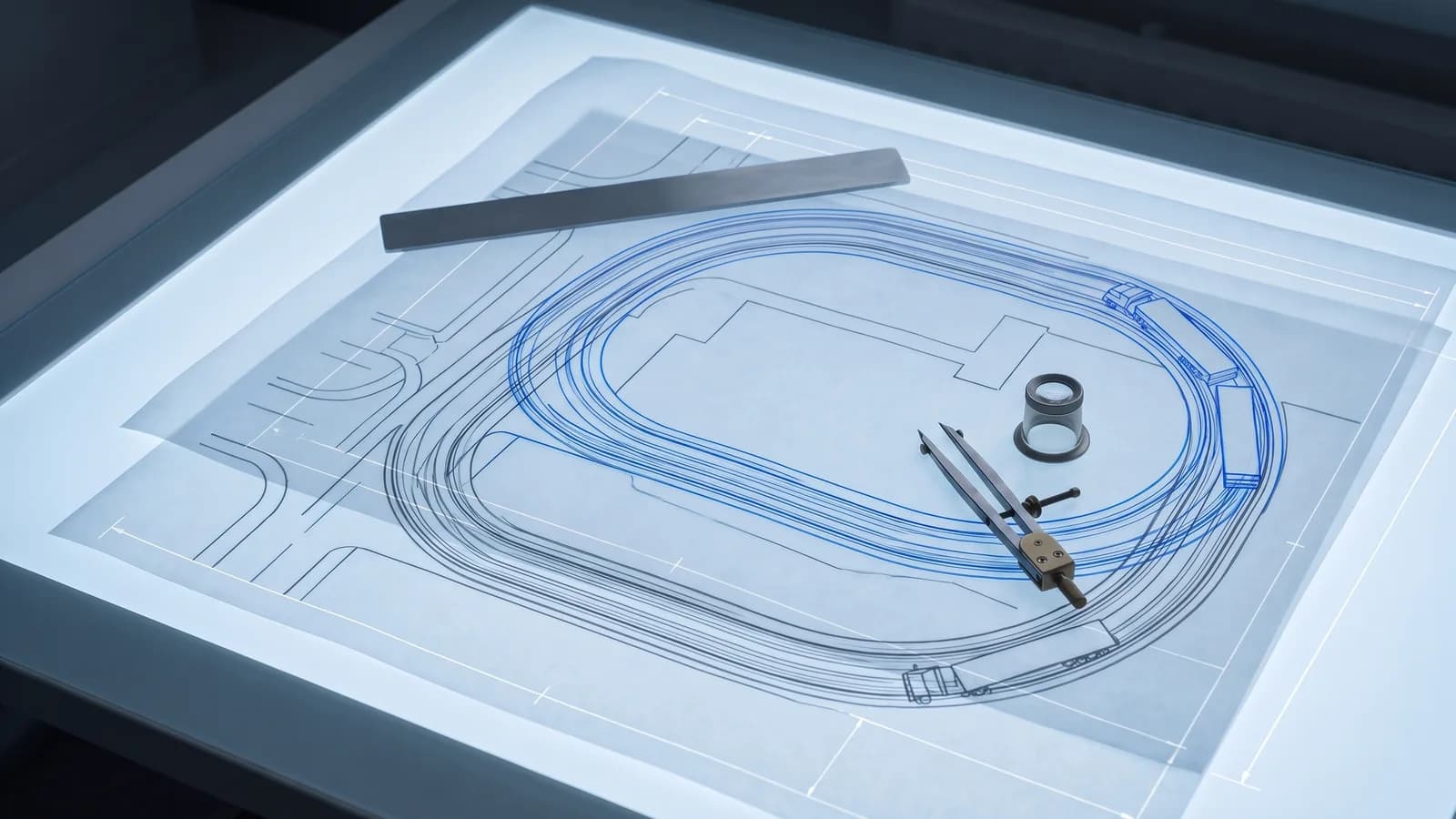
Several pages on this site say that PathSweeper's swept-path engine agrees with AutoTURN Online reference exports to within 0.5 percent of envelope area. A sentence like that is only worth something if the numbers behind it can be inspected. This page is the record: what was compared, how, every per-vehicle result, and the cases where the two tools differ by design.
One thing up front: this is our own validation of our own product, run by us against exports from an AutoTURN Online subscription we hold. It is not a third-party audit. What it is, is reproducible: anyone with access to both tools can drive the same vehicles on the same paths and compare.
What was compared
Reference data. On 18 July 2026 we exported two drawings from AutoTURN Online, each containing all 13 German RBSV 2020 design vehicles driving the same set of manoeuvres: one with steering at standstill (RBSV Fahrweise 2, the wheels reach full lock instantly) and one with steering while moving (Fahrweise 1, the steering angle changes at a finite rate while the vehicle rolls). A third export, from August 2026, contains the semi-trailer reversing along a straight lead-in and a 6.76 m arc, guided on the trailer axle as AutoTURN does. The DWG files were converted to DXF with the open-source LibreDWG converter and the entities were read from the DXF: the body envelope, the wheel envelope, the body boxes at the end position and the drive line.
Same path, our engine. AutoTURN's drive line is the trace of the front-axle centre with that steering mode already baked in. We convert it to the rear-axle path by exact tractrix pursuit, then run it through PathSweeper's production engine and envelope pipeline, exactly as the app does when you draw a path. Nothing in the engine knows it is being tested.
Metrics. For each case we report:
- Area difference: PathSweeper's envelope area minus the reference area, as a percentage of the reference. Negative means ours is smaller.
- Mean boundary deviation: sample points along PathSweeper's envelope boundary, measure the distance from each to the nearest point of the reference boundary, average. Median likewise.
- Maximum one-sided deviation, in both directions: the largest distance from a point on our boundary to the reference (ours → ref) and from a point on the reference boundary to ours (ref → ours). A large value in only one direction means one envelope has a lobe the other lacks.
The vehicle dimensions are the RBSV 2020 values in both tools. PathSweeper ships them with the permission of the FGSV Verlag.
Results
All 26 forward cases, 13 vehicles in each steering mode. Deviations in centimetres.
| Vehicle | Steering | Area diff. | Mean dev. (cm) | Median (cm) | Max ours → ref (cm) | Max ref → ours (cm) |
|---|---|---|---|---|---|---|
| Passenger car | while moving | -0.08 % | 0.4 | 0.3 | 1.7 | 1.4 |
| Passenger car | at standstill | +0.06 % | 0.3 | 0.2 | 0.8 | 0.8 |
| Van | while moving | -0.05 % | 0.3 | 0.3 | 1.4 | 1.2 |
| Van | at standstill | +0.04 % | 0.3 | 0.3 | 0.7 | 0.8 |
| 2-axle truck | while moving | +0.00 % | 0.4 | 0.3 | 2.0 | 1.9 |
| 2-axle truck | at standstill | +0.03 % | 0.4 | 0.3 | 0.9 | 0.9 |
| 3-axle truck | while moving | +0.02 % | 0.3 | 0.2 | 2.1 | 2.0 |
| 3-axle truck | at standstill | +0.04 % | 0.2 | 0.2 | 0.6 | 0.6 |
| 12 m bus | while moving | -0.00 % | 0.4 | 0.3 | 2.0 | 1.9 |
| 12 m bus | at standstill | +0.02 % | 0.3 | 0.2 | 0.8 | 0.8 |
| 13.7 m bus | while moving | +0.02 % | 0.4 | 0.3 | 2.1 | 1.9 |
| 13.7 m bus | at standstill | +0.02 % | 0.3 | 0.2 | 0.8 | 0.8 |
| 15 m bus | while moving | +0.03 % | 0.4 | 0.2 | 1.9 | 1.8 |
| 15 m bus | at standstill | +0.02 % | 0.3 | 0.2 | 0.8 | 0.8 |
| Articulated bus | while moving | -0.10 % | 0.9 | 0.3 | 2.9 | 3.0 |
| Articulated bus | at standstill | -0.02 % | 1.1 | 0.4 | 14.8 | 16.0 |
| Refuse truck 3Mü | while moving | +0.04 % | 0.4 | 0.2 | 2.1 | 1.9 |
| Refuse truck 3Mü | at standstill | +0.04 % | 0.2 | 0.3 | 0.7 | 0.7 |
| Refuse truck 3MüN | while moving | +0.11 % | 0.5 | 0.4 | 2.9 | 2.4 |
| Refuse truck 3MüN | at standstill | +0.03 % | 0.3 | 0.3 | 0.8 | 0.8 |
| Truck with drawbar trailer | while moving | -0.04 % | 1.5 | 0.4 | 8.1 | 8.1 |
| Truck with drawbar trailer | at standstill | +0.07 % | 2.2 | 0.6 | 9.8 | 15.6 |
| Truck with centre-axle trailer | while moving | +0.46 % | 1.8 | 0.3 | 2.3 | 127.1 |
| Truck with centre-axle trailer | at standstill | +0.50 % | 1.5 | 0.2 | 3.0 | 127.3 |
| Semi-trailer | while moving | +0.09 % | 1.4 | 0.3 | 35.0 | 49.1 |
| Semi-trailer | at standstill | +0.12 % | 1.5 | 0.4 | 35.5 | 49.8 |
Twelve of the thirteen vehicles agree within 0.13 percent of area in both steering modes, with a mean boundary deviation of 2.2 cm or less. The truck with centre-axle trailer sits at 0.5 percent because of one documented modelling difference, explained below.
The one reverse case:
| Vehicle | Steering | Area diff. | Mean dev. (cm) | Median (cm) | Max ours → ref (cm) | Max ref → ours (cm) |
|---|---|---|---|---|---|---|
| Semi-trailer | reverse, guided on trailer axle | -2.45 % | 9.9 | 1.8 | 139.3 | 126.2 |
Known differences
Two cases differ by more than the rest, and in both the cause is a modelling decision rather than a numerical error.
Centre-axle trailer: the towbar corridor. AutoTURN sweeps the drawbar between the truck and the centre-axle trailer as part of the envelope. PathSweeper sweeps vehicle bodies, not the towbar, so at full articulation the reference shows a one-sided lobe of up to 1.27 m between the units that ours lacks. That lobe is the whole 0.5 percent area difference; outside it the two boundaries agree to 3 cm. We reviewed the overlaid envelopes and kept our modelling: the towbar is not body envelope, and a corridor that only exists between the units does not change clearance to anything outside the combination.
Semi-trailer reversing: when the tractor starts to swing. In the reverse export the reference begins the tractor's swing during the straight lead-in, before the arc; PathSweeper starts it at the junction. The result is a one-sided fan of about 1.2 to 1.4 m at the start of the arc and an envelope 2.5 percent smaller than the reference. Reverse manoeuvres with articulated vehicles depend on how the driver is assumed to anticipate the turn, and the two tools make different assumptions. We document this rather than tune our model to match.
What this shows, and what it does not
It shows that, on identical paths with identical vehicle dimensions, PathSweeper's forward swept envelopes are the same as AutoTURN Online's to within the width of a pencil line at plan scale. It does not prove either tool correct: two implementations can agree and both be wrong. For that reason the engine is also audited against the analytic tractrix solution of the vehicle model, independent of any other software.
The table covers the German RBSV 2020 vehicles only. A similar comparison was run for the Australian Austroads library in July 2026 and is not yet tabulated here. Reverse manoeuvres are covered by a single case. Both are gaps we intend to close as further reference exports become available.
How this is maintained
The comparison is a regression suite inside the PathSweeper repository and runs on every change to the geometry engine. Each case carries a tolerance; a tolerance is never loosened to make a failing engine change pass, and the two cases with documented differences carry notes naming the difference they cover. The numbers on this page are the suite's output on 9 October 2026 and will be refreshed when the engine changes.
We do not publish Transoft's export files themselves, which are their intellectual property. The numbers in the table are our own measurements. Overlay drawings of the two envelopes exist for every case and can be shown on request.
AutoTURN, AutoTURN Online and InSTRATO are trademarks of Transoft Solutions Inc. They are named here only to identify the reference software; PathSweeper is not affiliated with or endorsed by Transoft Solutions, and Transoft has not reviewed this comparison.
For how the swept path itself is computed, see the swept path analysis guide. For how the two products compare on features and price, see PathSweeper vs AutoTURN Online.