Fire Truck Access (DIN 14090): Sources and Alternatives
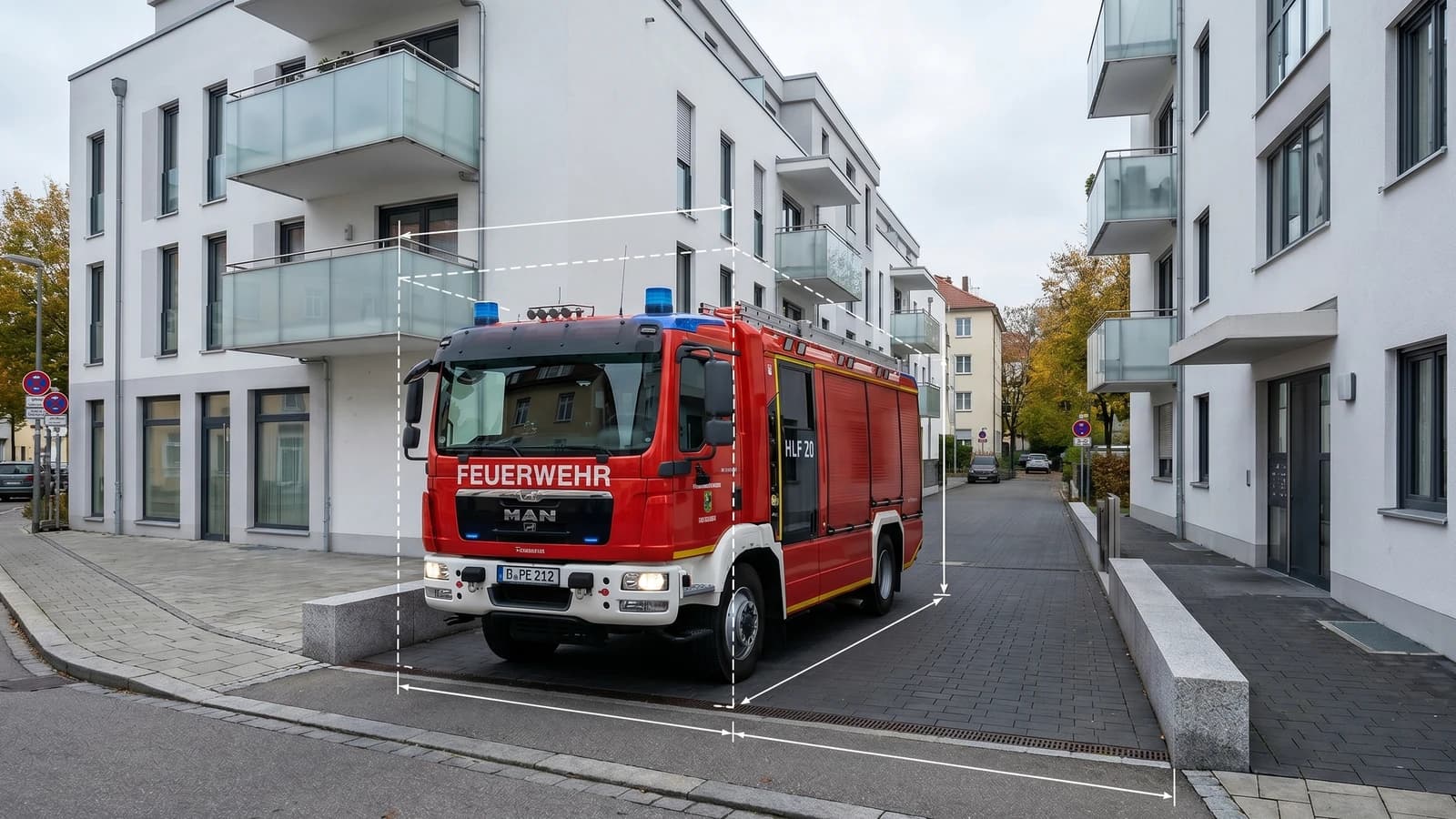
DIN 14090 ("Areas for fire brigades on properties") is the German standard that defines geometric and structural minimum requirements for fire access roads, manoeuvring areas and setup areas for high-rise rescue vehicles. This article explains what DIN 14090 covers, why the values are not freely available online, how to source them legally, and which values you may use in pre-design via the federal-state guidelines and publicly available manufacturer data. A short comparison with the US framework (IFC, NFPA) is included at the end.
What DIN 14090 Regulates
The current edition DIN 14090:2024-02 (replacing 2003-05) sets out the minimum dimensions and bearing capacity an access road must satisfy so that responding fire apparatus can reach the building safely. Regulated topics include carriageway width and height, maximum longitudinal slope, pavement bearing capacity, curve radii, and the size and arrangement of setup areas for aerial apparatus. The design vehicle is typically the DLK 23/12 (turntable ladder) per DIN EN 14043:2014-04 and DIN SPEC 14502-1:2016-12.
DIN 14090 itself is not a statute, but it becomes binding via the Landesbauordnungen (federal-state building codes) and their technical administrative regulations. Which edition is officially adopted is determined by each federal state.
Why DIN 14090 Is Not Freely Available
DIN standards are published by DIN Media GmbH (formerly Beuth Verlag) and distributed exclusively there. The content and tables of the standard are copyright-protected; a structured online reproduction would be unlawful. That is why search engines surface only fragments and partly contradictory numbers.
An important distinction: individual factual values (such as a minimum width of 3 m) are not protected under § 2 (2) UrhG. What is protected is the work as a whole — its structure, table layout and wording. The administrative regulations of the federal states, which adopt these core values into building law, are official works under § 5 UrhG and therefore in the public domain.
Three Legal Paths to DIN 14090
1. Buy the standard from DIN Media. The original standard and its companion documents for the aerial ladder are available from DIN Media:
- DIN 14090:2024-02 – Areas for fire brigades on properties — 90,50 €
- DIN EN 14043:2014-04 – Turntable ladders with combined movements — 209,50 €
- DIN SPEC 14502-1:2016-12 – Fire-fighting vehicles: vehicle masses and overview — 35,70 €
- DIN 14502-3:2022-03 – Coloration and markings — 105,20 €
Required for any certified verification submitted to a building authority or fire prevention office.
2. Use CAD software with a licensed fire apparatus catalog. The following programs include DIN-conformant fire apparatus templates as part of their subscription:
- Autodesk Vehicle Tracking
- AutoCAD Civil 3D (Country Kit DACH)
- Bentley OpenRoads Designer
- BricsCAD Pro
- CARD/1
- ProVI
- Trimble Novapoint
Sensible if you already work in this CAD ecosystem.
3. Rely on the public-domain alternative via the federal-state guidelines. Each German federal state publishes its own "Guideline on Fire Brigade Areas" as an administrative regulation under the corresponding Landesbauordnung. These publications are official works under § 5 UrhG and therefore public domain. They adopt the core values of DIN 14090 (minimum width, vertical clearance, bearing capacity, setup areas) verbatim or by reference. Examples:
- Bavarian Guideline on Fire Brigade Areas – Bayerisches Staatsministerium für Wohnen, Bau und Verkehr
- Hamburg Model Guideline on Fire Brigade Areas – Freie und Hansestadt Hamburg
For private projects and pre-design this is the cleanest legal source.
When Do You Need the Licensed DIN — and When Is the Free Alternative Enough?
| Situation | Recommendation |
|---|---|
| Special structure (high-rise, assembly venue, care home) | Original DIN 14090 + DIN EN 14043 + written confirmation from the fire prevention office |
| Public tender that names DIN 14090 | Original DIN or licensed CAD software |
| Regular residential building / pre-design / feasibility | Federal-state guideline + manufacturer datasheets |
| Teaching / research / journalism | Citation of individual values permitted, full table reproduction is not |
| In doubt | Written request to the responsible building authority before starting |
Many fire prevention offices accept verifications based on the federal-state guideline as long as all relevant values are covered. Clarify this before construction — it saves later rework.
Where DIN 14090 Applies in Practice
The standard is consulted in the following planning steps:
- Location and minimum dimensions of fire access roads
- Bearing capacity of pavements (paving, grass pavers)
- Curve radii for negotiability with the design vehicle
- Size and location of setup areas for aerial apparatus
- Manoeuvring areas in front of the rescue-relevant facade
- Turning areas in dead-ends (in conjunction with RASt 06)
Typical Market Values for the Aerial Ladder DLK 23/12
The following table is not a reproduction of the licensed standard dimensions from DIN EN 14043 / DIN SPEC 14502-1. It is based on publicly available manufacturer data sheets (Magirus, Rosenbauer, Iveco, Schlingmann, Ziegler) and is intended as a conservative pre-design envelope. For special structures and certified verification, the licensed DIN documents must be used.
| Property | Value |
|---|---|
| Overall length | ca. 9.80 – 10.30 m |
| Width (without mirrors) | 2.50 m |
| Wheelbase | ca. 4.50 – 5.00 m |
| Front overhang | ca. 1.30 – 1.70 m |
| Rear overhang | ca. 3.20 – 3.80 m (with cage) |
| Curb-to-curb turning circle | ca. 19.5 – 20.5 m |
| Maximum axle load | 10.5 – 12 t |
Source: publicly available manufacturer data sheets and bodybuilder guidelines (Magirus M32L-AT, Rosenbauer L32A-XS, Iveco Magirus DLK 23/12). These are not licensed DIN values. All information without warranty.
Note for the US: IFC, NFPA and Their Licensing
In the United States, fire apparatus access is governed by the International Fire Code (IFC, 2024 Edition) issued by the ICC, and by the NFPA 1 Fire Code (2024), with apparatus dimensions defined by NFPA 1900 (2024) — the consolidated standard that replaces NFPA 1901, NFPA 414, NFPA 1906 and NFPA 1917.
Both bodies of standards are copyright-protected. NFPA offers free read-only online access to many of its codes via NFPA's free access portal; ICC offers a similar reading mode via codes.iccsafe.org. For binding citations in design submittals or tenders, the licensed publication must be obtained from the publisher. The legal handling is therefore similar to DIN: individual factual values may be quoted, but a structured reproduction of tables is not allowed.
For pre-design in the US, manufacturer datasheets from Pierce, E-ONE, Spartan, KME, Rosenbauer, Magirus, Ziegler and Schlingmann are the equivalent of the German publicly-available datasheets and may be freely used.
Conclusion
DIN 14090 is the authoritative reference for fire access roads in Germany — but it is not free of charge. Anyone who understands the legal landscape can deliberately choose between the licensed standard and the public-domain alternative via the federal-state guideline, avoiding both unnecessary licensing costs and expensive permit revisions later. For regular residential buildings and pre-design, the values from the official federal-state guidelines combined with publicly available manufacturer datasheets are usually fully sufficient.
Related Guides
- Swept Path Analysis: The Complete Guide for Planners – Ackermann steering geometry, vehicle parameters and the legal landscape around design vehicle data.
- RBSV 2020 Design Vehicles Explained – the sister topic for general design vehicles: FGSV, StVZO and free alternatives.
PathSweeper supports the pre-design of fire access roads with swept paths based on publicly available manufacturer data. For certified verification submitted to a building authority or fire prevention office, the licensed DIN 14090 is required.